
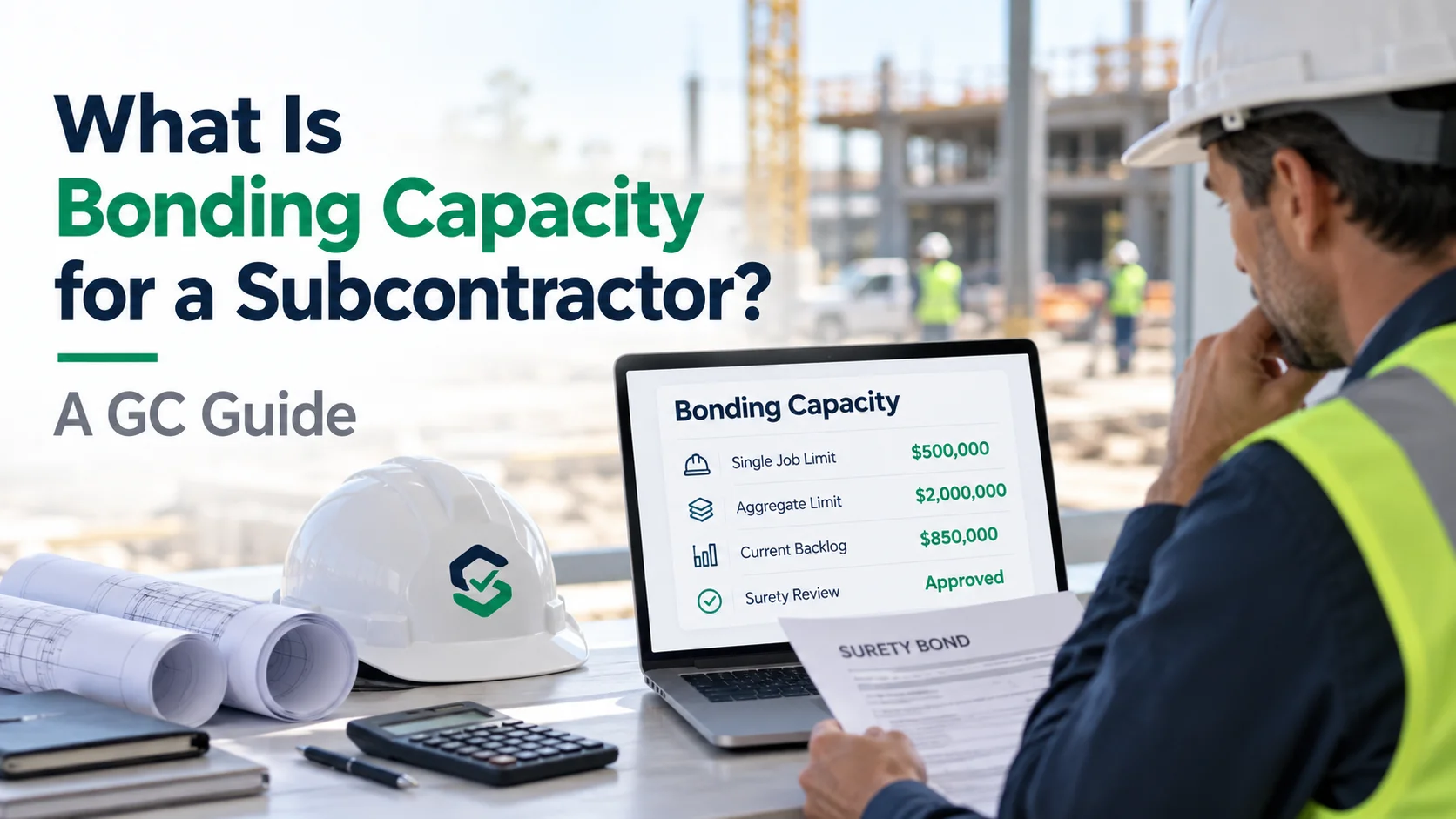
What Is Bonding Capacity for a Subcontractor? A GC Guide
When a general contractor evaluates a subcontractor for a large or higher-risk scope, one question often comes up: Can this subcontractor actually support the size of work being considered?
Bonding capacity can provide one useful piece of that answer.
A subcontractor may have years of experience, strong references, current insurance, and a good safety record, but the size of its surety program can still limit the work it can reasonably support. For GCs, understanding bonding capacity is therefore less about collecting a number and more about understanding what that number means in the context of the proposed subcontract, current workload, financial strength, and project risk.
This guide explains bonding capacity in practical terms, including single-project limits, aggregate capacity, available capacity, surety letters, warning signs, and how GCs can document the review.
What is bonding capacity?
Bonding capacity is the amount of surety credit a contractor or subcontractor may qualify for under its surety relationship. It is typically discussed in terms of how large an individual bonded job can be and how much bonded work the contractor can carry at one time.
The exact amount is determined by the surety based on its underwriting assessment. Factors can include financial strength, working capital, net worth, profitability, project history, management experience, current backlog, and the nature of the proposed work.
The important point for a GC is that bonding capacity is not a universal rating assigned to a subcontractor. It is part of a specific surety relationship and can change as the subcontractor's circumstances change.
Current surety guidance describes bonding capacity using two important measures: a single bond limit and an aggregate bonding capacity. urlIntegrity Surety: Subcontractor bonding capacity guidehttps://integritysurety.com/subcontractor-prequalification-bonding-capacity-and-surety-limits-what-contractors-need-to-know/
What is a single-project bond limit?
The single-project limit is the largest individual bonded job or subcontract the surety may be willing to support for the subcontractor, subject to the actual underwriting and project.
For example, imagine a subcontractor has:
- Single-project limit: $2 million
- Aggregate capacity: $6 million
A $1.5 million bonded subcontract may fall within the stated single-project limit. A $2.5 million subcontract may require additional surety review or may not fit the current program.
The limit is not a guarantee that every project below that amount will automatically be bonded. The surety can consider the specific project, contract terms, subcontractor's current financial position, and existing commitments.
For a GC, the practical question is therefore not simply “What is the single limit?” but “Does the proposed subcontract fit comfortably within the subcontractor's current surety program?”
What is aggregate bonding capacity?
Aggregate capacity refers to the total amount of bonded work a subcontractor may have outstanding at one time under the surety program.
Using the same example, a subcontractor might have a $2 million single limit and $6 million aggregate capacity. If the company already has $5 million of bonded work outstanding, its remaining aggregate room may be materially smaller than the headline $6 million figure suggests.
This matters because a new subcontract does not exist in isolation. A company that looks capable of handling a $1 million job on paper may be much more constrained if it is already carrying a heavy workload.
The National Roofing Contractors Association's subcontractor prequalification guidance recommends obtaining a surety or agent reference that identifies single-job and aggregate bonding capacity, and it also recommends annual financial statements as part of prequalification. urlNRCA subcontractor prequalification guidancehttps://nrcawebstorage.blob.core.windows.net/files/nrca_website/documents/insurance/Subcontractor_Prequalification.pdf
Bonding capacity vs. available bonding capacity
These terms should not be treated as interchangeable.
Bonding capacity is the size of the surety program or stated limits.
Available capacity is the room that remains after considering the subcontractor's existing bonded commitments and other relevant underwriting factors.
A GC should be careful when a subcontractor supplies only a letter showing a large aggregate limit. The more useful question is how much capacity is actually available for the proposed work at the time of the award.
For example:
| Item | Example |
|---|---|
| Aggregate capacity | $10 million |
| Existing bonded work | $7 million |
| Approximate remaining room | $3 million |
| Proposed subcontract | $2 million |
The example does not mean the subcontractor automatically qualifies. It simply shows why remaining capacity can be more informative than the headline limit.
Why do GCs review bonding capacity?
A GC may review bonding capacity for several reasons.
1. To assess project size fit
A subcontractor that normally performs $500,000 scopes may face a very different risk profile when asked to take a $5 million package.
Bonding information can help the GC identify whether the proposed award is within the subcontractor's established operating and surety capacity.
2. To understand financial underwriting signals
A surety relationship can provide useful third-party context because sureties evaluate the contractor's financial and operational position when establishing their program.
That does not make the surety letter a replacement for the GC's own prequalification process. It is one piece of evidence.
3. To evaluate larger or bonded work
When the subcontract requires a performance or payment bond, the surety's willingness to support the specific work becomes directly relevant.
4. To identify overextension risk
A subcontractor with a large backlog and limited remaining capacity may deserve closer review even if its historical performance has been strong.
What should a GC ask for?
The exact documentation should follow the project's contract and qualification policy, but a useful bonding review may include:
- Current surety or bonding letter
- Surety company name
- Surety agent or broker contact
- Single-project limit
- Aggregate limit
- Date of the letter
- Existing or available capacity when provided
- Largest completed project, when relevant
- Bonding rate or other information when required by the project
- Financial information required by the qualification process
A current letter is generally more useful than an old document copied from a prior qualification packet.
What should a GC verify on the surety letter?
Confirm the subcontractor identity
Make sure the letter relates to the same legal entity that will sign the subcontract. Parent companies, affiliates, DBAs, and related entities can create confusion.
Check the date
Record when the letter was issued. A capacity statement from a prior year may not represent the company's current position.
Identify both limits
Where applicable, record both the single-project and aggregate limits. Do not capture only one number if the source provides both.
Ask about current capacity when needed
A headline aggregate limit does not tell you how much capacity is already committed. For larger awards, the GC may need confirmation of the subcontractor's current available capacity from the appropriate surety contact.
Check the proposed scope
Capacity is not just a dollar calculation. The surety may consider whether the subcontractor has experience with the proposed trade, contract size, location, delivery method, or unusual contract conditions.
Is bonding capacity the same as prequalification?
No.
Bonding capacity is a surety underwriting measure. Prequalification is the GC's broader evaluation of whether the subcontractor is appropriate for the proposed work.
A GC's prequalification process can include:
- Insurance
- Licensing
- Safety history
- Financial information
- Bonding
- Project experience
- References
- Current workload
- Staffing
- Equipment
- Quality history
- Compliance documentation
Current construction prequalification guidance similarly treats bonding as one part of a broader assessment. urlDPR subcontractor prequalification programhttps://www.dpr.com/subcontractor-prequalification
A subcontractor can therefore have strong bonding capacity and still be unsuitable for a particular scope. Conversely, a subcontractor without a large bonding program may still be appropriate for work that does not require bonding, depending on the GC's qualification standards.
What can reduce a subcontractor's bonding capacity?
There is no universal formula that predicts the answer for every surety, but several factors commonly matter.
Weak working capital
Working capital is the difference between current assets and current liabilities. A subcontractor that lacks sufficient liquidity may have difficulty funding payroll, materials, and project costs before receiving progress payments.
Declining profitability
Repeated losses can raise questions about estimating, project management, cost control, or the company's ability to absorb another difficult project.
Heavy backlog
A strong backlog can be positive, but too much work relative to available resources can become a risk. A surety may consider how much work the subcontractor already has underway.
Limited experience with larger work
A subcontractor that has historically completed $500,000 projects may need additional underwriting support before taking on a $5 million package.
Rapid growth
Fast expansion can increase working-capital needs, staffing pressure, management complexity, and exposure to unfamiliar contract conditions.
Financial reporting concerns
Incomplete or stale financial information makes it harder for a surety or GC to understand current financial strength.
Should a GC require every subcontractor to be bonded?
Not necessarily.
Bond requirements depend on the contract, owner requirements, project risk, subcontract value, public-works rules, and the GC's risk-management strategy. Some subcontractors may be required to provide bonds while others may not.
The decision should be documented rather than applied automatically to every trade.
For a large structural package, critical-path scope, or owner-mandated bonded subcontract, bonding may be particularly relevant. For a smaller scope, the GC may use a different qualification approach.
Bonding capacity red flags for GCs
A warning sign is not an automatic rejection. It is a reason to investigate.
Potential review triggers include:
- The single-project limit is close to the proposed subcontract value.
- Aggregate capacity appears heavily committed.
- The bonding letter is materially outdated.
- The surety information does not match the subcontracting entity.
- The proposed project is much larger than the subcontractor's historical work.
- The subcontractor is entering an unfamiliar trade, market, or contract type.
- Financial information shows a deterioration that is not explained.
- The subcontractor cannot provide current surety information when the contract requires it.
How should bonding capacity be documented in a compliance workflow?
Avoid putting the entire review into a single spreadsheet note.
A useful record can include:
| Field | Example |
|---|---|
| Subcontractor | ABC Mechanical LLC |
| Surety | Example Surety Company |
| Letter date | September 2026 |
| Single-project limit | $2M |
| Aggregate limit | $6M |
| Proposed subcontract | $1.5M |
| Available capacity confirmed | Yes / No / Pending |
| Reviewer | Preconstruction team |
| Review date | September 2026 |
| Exception | None / documented |
This gives the project team a clear record of what was actually reviewed.
How SubCada fits into the process
SubCada does not determine bonding capacity and does not replace a surety, broker, financial adviser, or GC risk decision.
Its role is the administrative side: keeping subcontractor qualification and compliance records organized so teams can see what documentation has been received, what needs review, and when information needs to be refreshed.
That becomes useful when the same subcontractor bids on multiple projects and the GC needs to retrieve the current qualification record instead of searching through old emails and attachments.
Bonding capacity review checklist
- [ ] Legal subcontractor entity verified
- [ ] Current surety/bonding letter received
- [ ] Surety identified
- [ ] Letter date recorded
- [ ] Single-project limit recorded
- [ ] Aggregate limit recorded
- [ ] Available capacity considered where relevant
- [ ] Proposed subcontract value compared with capacity
- [ ] Existing workload considered
- [ ] Similar project experience reviewed
- [ ] Financial information reviewed where required
- [ ] Exceptions documented
- [ ] Reviewer and review date recorded
- [ ] Refresh trigger established
Frequently asked questions
What does bonding capacity mean for a subcontractor?
It describes the amount of surety support the subcontractor may qualify for, usually expressed through individual project and aggregate limits.
What is the difference between single and aggregate bonding capacity?
The single limit concerns one bonded project, while the aggregate limit concerns the total bonded work the subcontractor can carry at one time under the surety program.
Does bonding capacity prove a subcontractor is financially healthy?
No. It is useful evidence of surety underwriting, but the GC should still consider current financial information, workload, experience, safety, insurance, and project fit.
Can a subcontractor have bonding capacity but still be rejected by a GC?
Yes. A GC can consider many factors beyond bonding, including safety, experience, staffing, insurance, references, schedule capacity, and project-specific requirements.
How often should bonding information be updated?
The appropriate frequency depends on the GC's policy and project risk. Current information should be obtained when a new award or material change makes the old information insufficient.
Final takeaway
Bonding capacity is best understood as one part of the subcontractor qualification picture. For GCs, the useful review is not just the largest number printed on a surety letter. It is the relationship between the subcontractor's single-project limit, aggregate program, existing commitments, financial strength, experience, and the proposed scope.
When that information is current and documented, the GC can make a more informed decision about whether the subcontractor is appropriately sized for the work.
This article is general informational content and is not legal, insurance, financial, accounting, or surety advice. Bonding requirements and underwriting decisions vary by surety, contract, project, jurisdiction, and subcontractor. Consult the applicable surety and qualified professionals for project-specific decisions.