

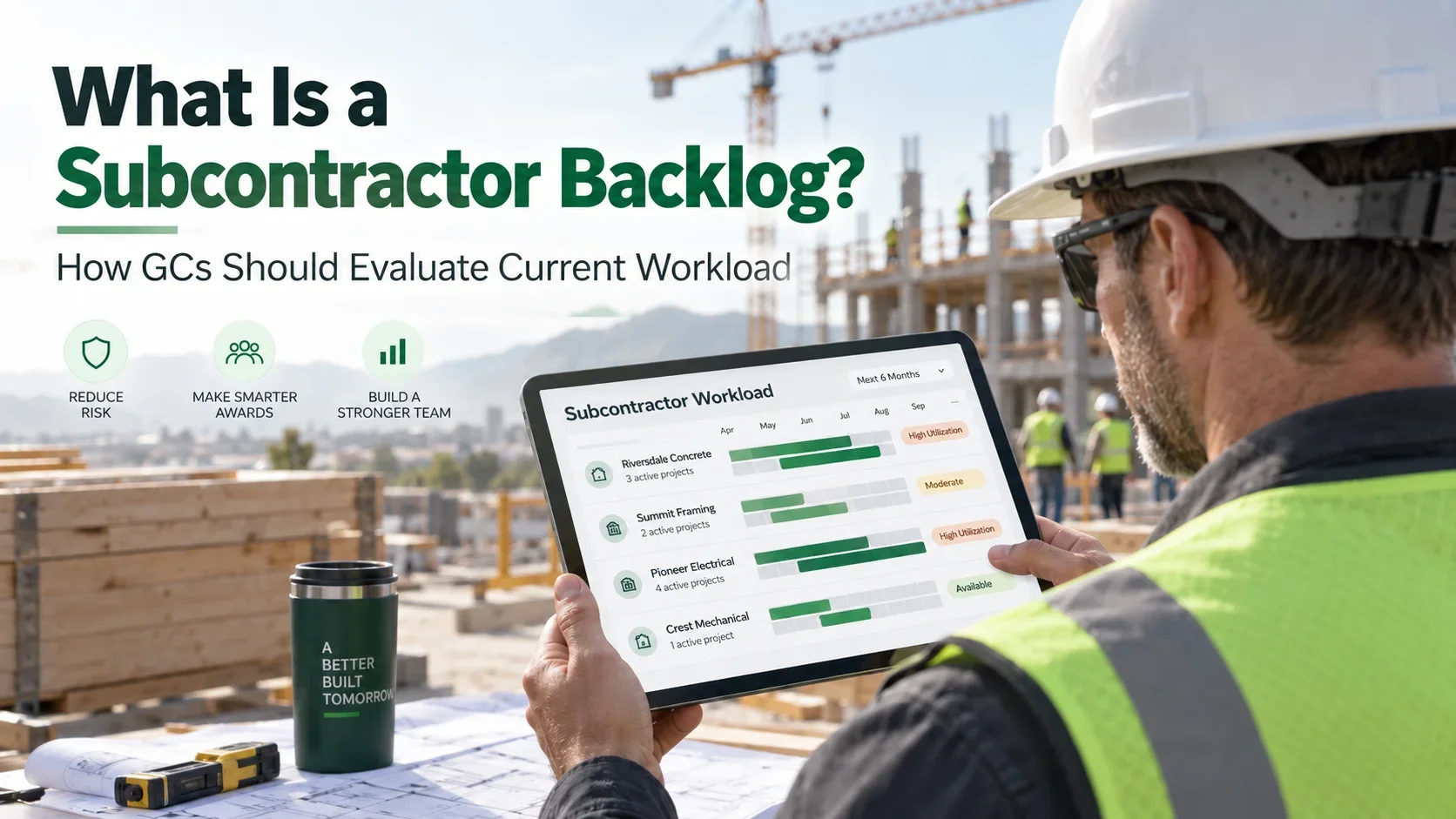
What Is a Subcontractor Backlog? How GCs Should Evaluate Current Workload
A subcontractor can have excellent references, current insurance, strong financial statements, and the right license—and still be a poor fit for a new project if its crews are already committed elsewhere.
That is why subcontractor backlog is an important part of prequalification and award review.
Backlog gives a general contractor a view of work that has already been awarded but is not yet complete. It can help answer a practical question that a traditional compliance packet may not answer:
Does this subcontractor actually have room to take on our project?
Backlog is not a guarantee of performance, and there is no universal backlog number that makes a subcontractor qualified or unqualified. The useful approach is to consider backlog alongside staffing, schedule, financial resources, bonding, project experience, and the proposed scope.
This guide explains what backlog means, how GCs can review it, what warning signs deserve follow-up, and how to document the review.
What is subcontractor backlog?
Construction backlog generally refers to the value of work that has been contracted or awarded but has not yet been completed.
For example, if a subcontractor has three signed projects worth $2 million each and has completed $1 million of work on each, the remaining backlog would be approximately $3 million, subject to the company's accounting and reporting method.
Backlog is therefore different from a sales pipeline. A bid that has not been awarded is not the same as contracted work.
Current construction resources describe backlog as a measure of committed future work and connect it with planning, financial capacity, and bonding decisions. urlWhat Is Construction Backlog and How Is It Calculated?https://legalclarity.org/what-is-construction-backlog-and-how-is-it-calculated/
Why should a GC review subcontractor backlog?
The main reason is capacity.
A subcontractor does not have unlimited crews, supervisors, equipment, working capital, or management attention. If a company already has a large amount of active work, another award may stretch its resources.
A backlog review can help a GC understand:
- How much work the subcontractor already has committed
- When major projects are scheduled to finish
- Whether the proposed project overlaps with existing work
- Whether the company has enough crews and supervision
- Whether one customer or project represents a large share of the backlog
- Whether the new award would materially change the company's workload
- Whether the subcontractor's financial and bonding capacity appears consistent with the workload
This is especially relevant for critical-path scopes where staffing problems can quickly affect the GC's schedule.
Backlog vs. pipeline: what is the difference?
These terms should not be mixed together.
Backlog is generally work that has already been awarded or contracted and remains to be performed.
Pipeline is potential future work that the subcontractor may bid on or expects to win but has not necessarily secured.
For a GC evaluating capacity, backlog is usually the more useful starting point because it represents commitments that already exist.
A subcontractor may tell a GC that it has $20 million of “work in the pipeline.” That does not necessarily mean the company has $20 million of contracted obligations.
Ask the subcontractor to distinguish:
- Signed contracts
- Awarded but not yet executed work
- Bids outstanding
- Letters of intent
- Opportunities still under negotiation
The exact treatment of each category should follow the GC's qualification policy and the subcontractor's reporting conventions.
What should a subcontractor backlog report include?
There is no single universal format, but a useful report may include:
| Field | Why it matters |
|---|---|
| Project name | Identifies the commitment |
| Owner/GC | Shows customer concentration |
| Contract value | Shows overall project size |
| Remaining value | Shows unfinished work |
| Scope | Helps compare with the proposed project |
| Start date | Shows resource timing |
| Expected completion | Shows when capacity may free up |
| Current status | Shows whether the project is active or delayed |
| Location | Helps assess travel and staffing |
| Bonded status | Useful where bonding is relevant |
The more detailed the proposed award, the more useful project-level backlog information can become.
Step 1: Compare backlog with the proposed project
Start with the simplest question:
How large is the new subcontract compared with the work already under contract?
Suppose a subcontractor has $4 million of remaining backlog and is bidding a $3 million project. That does not automatically mean the award is too large. The company may have strong working capital, multiple crews, a history of handling larger volumes, and projects scheduled to finish before the new work peaks.
But it does mean the GC should ask more questions.
The proposed award should be considered in the context of the subcontractor's actual capacity, not just its historical revenue.
Step 2: Look at project completion dates
Backlog is a time-based resource problem as much as a dollar-value problem.
Two subcontractors could each have $10 million of backlog but face very different workloads.
Subcontractor A:
- $10M backlog
- Major projects spread over 24 months
- Several crews available
- New project starts after a major project closes
Subcontractor B:
- $10M backlog
- Most projects peak during the next four months
- Same crews are already committed
- New project starts during the busiest period
The second situation deserves much closer review.
Ask for expected start and completion dates and compare them with the schedule of the project being awarded.
Step 3: Review staffing capacity
Dollar value alone cannot tell you whether a subcontractor can perform the work.
A GC should consider:
- Number of field crews
- Superintendents and foremen
- Project managers
- Specialized labor
- Expected overtime
- Hiring plans
- Subcontracted portions of the work
- Equipment availability
For example, an electrical subcontractor may have $15 million of backlog but only enough experienced supervisors to manage a limited number of simultaneous projects.
If the proposed project requires a dedicated superintendent and the subcontractor has already committed its available supervisors, the dollar value of backlog may understate the actual capacity problem.
Step 4: Consider geographic concentration
A subcontractor may have enough total labor but still face logistical problems if its backlog is spread across distant markets.
Ask:
- Where are the active projects located?
- Where is the subcontractor's primary office or yard?
- How far is the proposed project from existing work?
- Does the company regularly operate in that market?
- Are travel, housing, or mobilization requirements significant?
Geographic expansion can be manageable for experienced companies, but a new market can also introduce unfamiliar labor, permitting, supplier, and management challenges.
Step 5: Look at customer concentration
Backlog quality matters as well as backlog quantity.
Suppose a subcontractor has $12 million of remaining work, but $9 million comes from one customer and one major project.
That concentration may deserve additional review because the company's future workload and cash flow could be heavily influenced by that relationship.
This does not mean concentration is automatically bad. Large repeat customers can be a strength. The point is to understand the exposure rather than treating the backlog total as the entire story.
Step 6: Compare backlog with financial capacity
Backlog should be considered alongside financial information.
A subcontractor may have a large amount of contracted work but limited working capital to finance labor and materials while waiting for payments.
For a broader explanation of financial documents, see What Financial Statements Should a GC Request From a Subcontractor?.
Useful questions include:
- Does working capital appear adequate for the current workload?
- Are receivables growing faster than cash?
- Is profitability stable?
- Are project losses reducing financial resources?
- Is the new award unusually large relative to the company's financial position?
The answer should be based on the GC's approved financial-review process, not an improvised ratio.
Step 7: Compare backlog with WIP
Backlog and WIP are related but different.
Backlog focuses on remaining contracted work. A WIP schedule can provide more detailed project-level information about costs, billings, percentage complete, and expected margins.
SubCada's separate guide, What Is a WIP Schedule for a Subcontractor? A GC Guide, explains the WIP review in more detail.
Using both can give the GC a better picture:
Backlog: What work remains?
WIP: How are active projects currently performing financially?
This distinction matters because a large backlog can look healthy until the GC discovers that several active projects are experiencing significant cost or schedule problems.
Step 8: Consider bonding capacity
Where bonding is relevant, compare backlog with the subcontractor's surety program.
For a separate explanation, see What Is Bonding Capacity for a Subcontractor? A GC Guide.
A subcontractor can have a $10 million aggregate bonding program but already have most of that capacity committed. The GC should therefore distinguish between the headline limit and available capacity.
Bonding capacity is not a substitute for backlog review, but the two can provide useful context when a subcontractor is taking on a large award.
Step 9: Review historical project size
Current backlog should be compared with what the subcontractor has actually demonstrated it can manage.
Ask:
- What is the largest project completed?
- What is the largest current project?
- How many projects has the company managed simultaneously?
- Has it worked under similar schedules?
- Has it successfully expanded into larger scopes before?
A company moving from $500,000 projects to a $5 million project may need deeper review even if its current backlog looks manageable.
That does not mean the company cannot grow. It means the GC should verify that the organization has the people, systems, financial resources, and experience to support the change.
Step 10: Watch for backlog warning signs
Potential warning signs include:
- Major backlog increase without corresponding staffing growth
- Several large projects peaking at the same time
- Proposed award materially larger than historical project experience
- Heavy customer concentration
- Significant geographic expansion
- Backlog growing while working capital declines
- Large projects showing margin deterioration on the WIP schedule
- Current backlog already consuming most of the subcontractor's bonding capacity
- Management unable to provide a reasonably current backlog report
These are review triggers, not universal disqualification rules.
Should a GC ask for backlog from every subcontractor?
Not necessarily.
A tiered process is often more practical.
Lower-risk work
For small, straightforward scopes, the GC may rely on a lighter capacity review.
Medium-risk work
The GC may request current backlog, active project information, and staffing details.
High-exposure or critical-path work
The GC may require a deeper review that connects backlog with financial statements, WIP, bonding, staffing, and comparable project experience.
The exact thresholds should be defined in the organization's qualification policy.
How often should backlog be updated?
There is no universal interval for every subcontractor.
The appropriate refresh frequency depends on project size, risk, the subcontractor's role, and the GC's qualification process.
A useful approach is to combine scheduled refreshes with event-based triggers.
Possible triggers include:
- A new major award
- A significant change in current workload
- A proposed subcontract materially larger than prior work
- A major project delay
- A significant staffing change
- A material financial change
- A change in bonding capacity
- A new market or geographic expansion
Current construction prequalification guidance increasingly emphasizes reviewing workload and capacity rather than treating prequalification as a permanent status. urlAI Construction University: Contractor prequalification overviewhttps://www.briq.ai/acu/object/prequalification
How should GCs document a backlog review?
A useful structured record can include:
| Field | Example |
|---|---|
| Backlog date | September 2026 |
| Total remaining backlog | $X |
| Largest active project | $X |
| Major completion dates | Dates |
| Proposed subcontract | $X |
| Staffing reviewed | Yes / No |
| Geographic fit | Reviewed |
| Customer concentration | Reviewed |
| WIP comparison | Completed / Not required |
| Financial comparison | Completed / Not required |
| Bonding comparison | Completed / Not required |
| Exceptions | None / documented |
| Reviewer | Preconstruction |
| Review date | September 2026 |
The exact fields should match the organization's process.
How SubCada can support the workflow
SubCada does not determine whether a subcontractor has enough capacity to perform a project. That remains a preconstruction, operational, financial, and risk-management decision.
The administrative challenge is keeping the supporting records organized.
A centralized subcontractor record can connect qualification documents, insurance, licenses, financial documents, WIP schedules, and other required records so the project team can see what has been collected and reviewed.
That is particularly useful when the same subcontractor bids on multiple projects and the team needs current qualification information without searching through old email attachments.
Subcontractor backlog review checklist
- [ ] Current backlog date recorded
- [ ] Contracted work separated from pipeline opportunities
- [ ] Remaining project values reviewed
- [ ] Major completion dates reviewed
- [ ] Proposed project schedule compared with existing commitments
- [ ] Staffing and supervision capacity considered
- [ ] Geographic workload considered
- [ ] Customer concentration considered
- [ ] Historical project size reviewed
- [ ] Financial capacity considered where required
- [ ] WIP information compared where required
- [ ] Bonding capacity considered where relevant
- [ ] Warning signs documented
- [ ] Follow-up questions assigned
- [ ] Reviewer and review date recorded
- [ ] Next refresh trigger established
Frequently asked questions
What is subcontractor backlog?
It is generally the value of contracted work that remains to be completed. It is different from a pipeline of bids or potential future awards.
Why should a GC care about a subcontractor's backlog?
Because backlog helps show how much work the subcontractor is already committed to and whether the proposed project may stretch staffing, management, equipment, or financial resources.
Is a large backlog good or bad?
Neither automatically. A large backlog can indicate strong demand, but it can also create capacity pressure if the company lacks sufficient resources to perform the work.
How does backlog differ from WIP?
Backlog focuses on remaining contracted work. WIP provides more detailed project-level information about active contracts, including costs, billings, and expected financial performance.
Should backlog be compared with bonding capacity?
When bonding is relevant, yes. The comparison can help the GC understand whether the subcontractor's current workload is consistent with its surety support and available capacity.
How often should a GC request a backlog update?
The appropriate frequency depends on risk and policy. Scheduled refreshes can be combined with event-based reviews when the subcontractor takes on a major new project or its workload changes materially.
Final takeaway
Subcontractor backlog is one of the clearest ways for a GC to ask whether a trade partner actually has room for another project.
But the backlog number alone is not enough. Review when the work occurs, which crews and managers are committed, how concentrated the backlog is, whether the company has the financial resources to support it, how active projects are performing, and whether bonding capacity is consistent with the workload when applicable.
The goal is not to reject subcontractors with large backlogs. It is to identify capacity questions early—before the project schedule depends on a crew that was already committed somewhere else.
This article is general informational content and is not legal, accounting, financial, insurance, or construction-management advice. Capacity requirements vary by company, trade, project, contract, and risk profile. Consult qualified professionals for project-specific decisions.