
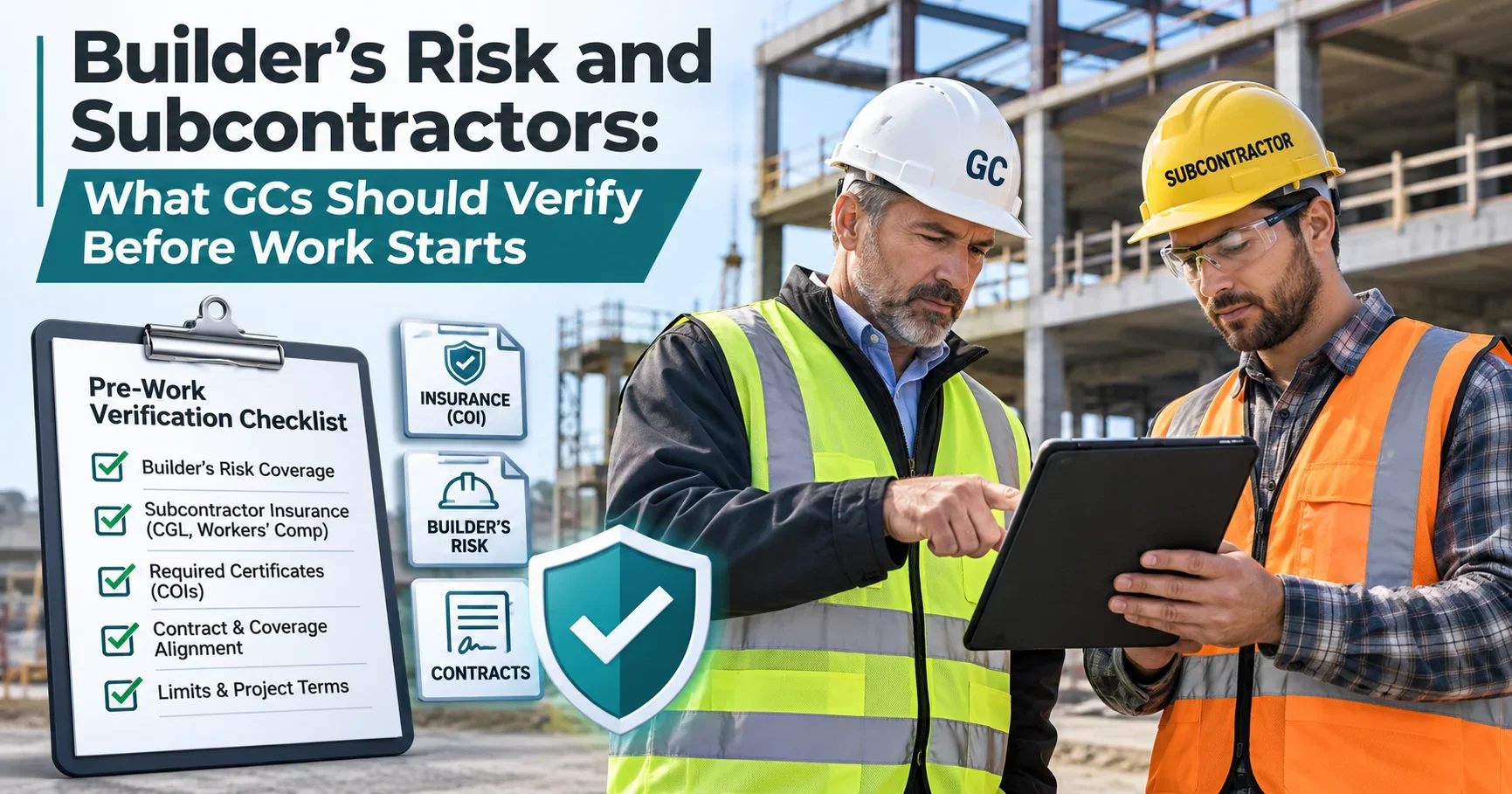
Builder’s Risk and Subcontractors: What GCs Should Verify Before Work Starts
Builder’s risk is different from the liability policies that dominate most subcontractor COI workflows. Instead of primarily addressing liability to third parties, builder’s risk generally protects covered construction property against covered causes of loss during the course of construction, subject to the policy’s terms, exclusions, deductibles and valuation provisions.
For general contractors, the difficult compliance question is often not “Does the subcontractor have builder’s risk?” It is who is responsible for arranging the project policy, whose interests are covered, what property is included, and what the subcontract requires the subcontractor to do.
Those answers vary significantly by project. The owner may purchase the policy, the GC may purchase it, or a contract may allocate property risks another way. This article provides a practical review framework, not legal or insurance advice.
What is builder’s risk insurance?
Builder’s risk—also called course-of-construction insurance—is property coverage designed for buildings and other covered property while construction is underway. The exact policy determines what property, causes of loss, locations and parties are covered.
A subcontractor should never be assumed to be protected merely because someone says “the project has builder’s risk.” The actual policy and contract matter.
Recent construction risk guidance continues to highlight questions around whether subcontractors are insured, whether off-site or in-transit materials are covered, how deductibles are allocated, and whether subrogation rights are waived. See Redline Construction Solutions’ builder’s risk overview.
Who usually buys builder’s risk?
There is no universal answer. Depending on the contract, the policy may be purchased by:
- the project owner;
- the general contractor;
- another designated party; or
- separate parties for particular property interests.
The compliance team should therefore start with the contract and project insurance specifications. Do not assume that a subcontractor must buy its own builder’s risk policy, and do not assume that an owner-controlled policy automatically covers every subcontractor interest.
What should a GC verify?
1. Who is responsible for obtaining the policy?
Identify the party responsible under the prime contract and related project documents. The subcontract should align with that allocation.
2. Are subcontractor interests addressed?
Determine how subcontractors are treated under the policy and contract. Are they insureds, additional insureds, loss payees, or otherwise protected for covered property? Those terms have distinct meanings and should not be treated as interchangeable.
If the project requires evidence of a particular insured status, confirm it through the required policy documentation rather than relying on an assumption.
3. What property is covered?
A project can involve property in several places:
| Property situation | Question to verify |
|---|---|
| Installed work | Is the work incorporated into the project within covered property? |
| Materials on site | Are materials awaiting installation covered? |
| Off-site fabrication | Does coverage extend to the relevant off-site location? |
| Property in transit | Does the policy cover materials while being transported? |
| Temporary works/equipment | Are these included, excluded or handled elsewhere? |
These questions matter for trades that fabricate expensive components away from the project before delivery.
4. What causes of loss and exclusions matter?
Builder’s risk policies are not identical. Water, flood, earthquake, wind, theft, testing, faulty workmanship, mechanical breakdown and other exposures may be treated differently depending on policy wording and endorsements.
A compliance administrator should not make coverage interpretations beyond their authority. The workflow should make it easy to flag the issue for the project’s broker or risk professional.
5. Who bears the deductible?
The policy may have a deductible, and the construction contracts may allocate responsibility for it. A subcontract can potentially shift some deductible responsibility to a trade whose work causes a loss.
Record the contractual requirement rather than inventing a default rule.
6. Is there a waiver of subrogation?
Subrogation provisions can materially affect project risk allocation. A waiver may restrict an insurer’s ability to pursue another project party after paying a covered loss, depending on the contract and policy.
SubCada’s waiver of subrogation guide explains the concept in more detail.
7. When does coverage start and end?
Course-of-construction coverage does not continue forever. Completion, occupancy, acceptance, policy expiration and other events can affect coverage depending on policy terms.
A GC should know the project’s required coverage period and make sure its administrative records do not assume coverage after the applicable policy has ended.
Builder’s risk vs. general liability
These coverages address different categories of risk.
| Builder’s risk | Commercial general liability |
|---|---|
| Primarily property-focused | Primarily third-party liability-focused |
| Often project-specific | Often contractor/subcontractor business policy |
| Covers defined construction property and causes of loss | Addresses covered bodily injury/property damage liability |
| May be purchased by owner or GC | Commonly maintained by each contractor/subcontractor |
The existence of one does not mean the other is unnecessary. Requirements should come from the project’s insurance program.
Builder’s risk vs. subcontractor tools and equipment
A subcontractor’s own tools, machinery and equipment may not be treated the same way as property that will become part of the project. Contractors often use equipment or inland-marine coverage for their own property exposures.
DPR’s published subcontract insurance requirements, for example, separately address subcontractor equipment/property insurance while also establishing other project insurance obligations. See DPR’s published requirements.
Again, that is an example—not a universal rule.
Common builder’s risk compliance mistakes
Assuming every subcontractor is automatically covered
The project having a policy does not answer whose interests or property are insured. Verify the policy and contract.
Ignoring off-site materials
Custom fabrication may represent significant value before materials arrive at the site. Confirm whether the project requires coverage for off-site storage and transit.
Confusing liability and property insurance
A subcontractor’s CGL certificate does not prove that its materials are protected under builder’s risk.
Forgetting deductibles
A covered loss can still create a substantial contractual deductible issue. Teams should understand who has authority to interpret and approve that allocation.
Failing to retain project-specific evidence
Builder’s risk is often project-specific. Keep relevant policy evidence and decisions tied to the correct project rather than a general vendor profile alone.
A practical GC checklist
For a project with builder’s risk, confirm as applicable:
- [ ] Party responsible for purchasing coverage identified
- [ ] Policy period recorded
- [ ] Project/location matches
- [ ] Subcontractor insured-interest requirement reviewed
- [ ] On-site materials treatment understood
- [ ] Off-site storage requirement reviewed
- [ ] Transit requirement reviewed
- [ ] Deductible allocation documented
- [ ] Waiver-of-subrogation requirement reviewed
- [ ] Special testing or commissioning exposures routed to risk team
- [ ] Completion/termination conditions understood by responsible team
- [ ] Exceptions documented
How builder’s risk fits into subcontractor compliance
Builder’s risk is not always a vendor-level requirement. Often it is a project-level insurance control that affects many subcontractors. That makes the data model important: the team needs to know which policy belongs to which project, which trades are affected, what documents support the decision, and who approved exceptions.
This differs from simply collecting a recurring subcontractor COI. For a broader look at recurring coverage, see SubCada’s Certificate of Insurance guide and subcontractor insurance requirements by trade.
Managing project insurance documentation in one workflow
Email and spreadsheets become especially fragile when project-level and subcontractor-level requirements overlap. One person may hold the builder’s risk policy, another the subcontract, and another the subcontractor’s certificate.
SubCada helps construction teams centralize subcontractor requirements, supporting documents, expiration dates, reminders and review status. For project-specific insurance such as builder’s risk, the goal is not automated coverage interpretation—it is clearer visibility into what has been collected, what still needs review and which exceptions were approved.
Frequently asked questions
Does a subcontractor need its own builder’s risk policy?
Not necessarily. Responsibility depends on the project contracts and insurance program. An owner or GC may arrange project coverage, but the subcontractor should confirm how its interests and property are treated.
Does builder’s risk cover subcontractor tools?
Do not assume so. Tools and equipment may require separate coverage depending on the policy and contract.
Are materials stored off site covered?
They may be, but coverage depends on policy terms, locations, limits and endorsements. Verify the actual project policy.
Does builder’s risk replace general liability?
No. They address different risks. A project can require both builder’s risk and contractor/subcontractor liability coverage.
Bottom line
Builder’s risk compliance starts with the project contract, not a generic checklist. Identify who buys the policy, determine how subcontractor interests are treated, review property locations and transit, understand deductible and subrogation provisions, and track the project-specific evidence. Clear documentation makes it far easier to resolve questions before a loss occurs.