
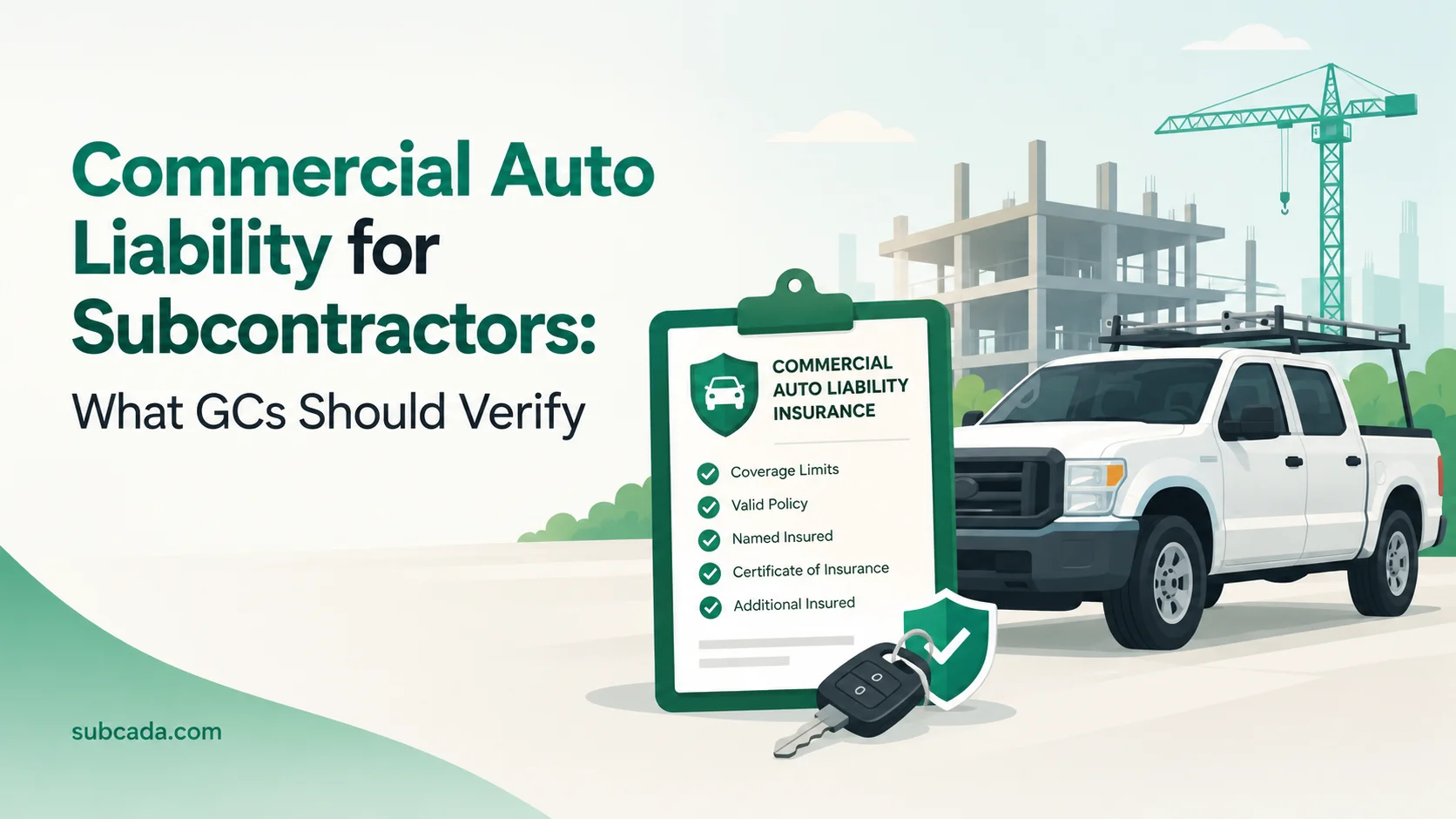
Commercial Auto Liability for Subcontractors: What GCs Should Verify
Vehicles create a separate construction risk that can be easy to overlook when a compliance team focuses mainly on general liability and workers’ compensation. A subcontractor may drive company trucks to the site, send employees in personal vehicles to pick up materials, rent a van for a project, or operate vehicles around an active jobsite. Whether commercial auto liability is required—and exactly what it must cover—depends on the subcontract, project, vehicle use, applicable law, and the organization’s risk program.
For a general contractor, the practical question is not simply “Does this subcontractor have auto insurance?” It is: Does the submitted evidence match the auto liability requirement created for this scope of work?
This guide explains a repeatable review process. It is general risk-management information, not legal or insurance advice. Requirements should be confirmed against the actual contract and with qualified insurance or legal professionals.
What is commercial auto liability?
Commercial auto liability generally addresses third-party bodily injury and property damage liability arising from covered vehicle use in business operations, subject to the policy’s terms, exclusions and covered-auto designations.
Construction contracts frequently require subcontractors with vehicle exposure to maintain automobile liability. For example, Orion Construction’s current subcontractor prequalification requirements call for automobile liability coverage, while DPR’s published subcontract insurance requirements address owned, hired and non-owned automobiles. See Orion’s subcontractor requirements and DPR’s insurance requirements.
Those examples are evidence of industry practice, not universal minimum requirements. A GC should always use its own contract requirements.
Owned, hired and non-owned autos: why the wording matters
One of the most useful distinctions for compliance reviewers is how vehicles are connected to the subcontractor.
| Vehicle exposure | Typical example | Review question |
|---|---|---|
| Owned auto | Company pickup or service van | Does the required coverage apply to vehicles the business owns? |
| Hired auto | Rental truck or leased vehicle | Does the requirement include hired autos? |
| Non-owned auto | Employee’s personal car used for business | Does the required policy address non-owned auto exposure? |
A subcontractor that owns no vehicles can still have vehicle exposure. An employee may drive a personal vehicle to deliver equipment, visit a supplier, or travel between projects. Likewise, a contractor may temporarily rent a vehicle.
That is why “no company vehicles” should not automatically close an auto-liability requirement. The compliance reviewer should determine what the subcontract requires and what vehicle activity the subcontractor will actually perform.
When should a GC require commercial auto liability?
The answer should come from the project’s insurance specification and risk review—not a generic internet rule. Auto liability is especially relevant when a subcontractor:
- owns or operates vehicles for project work;
- transports materials, tools or equipment;
- rents vehicles for project operations;
- sends employees on business errands in personal vehicles;
- makes deliveries or pickups;
- operates vehicles within a controlled jobsite; or
- performs a transportation-heavy scope.
A GC may also have a standard subcontract requiring auto liability regardless of the specific trade. If so, the compliance team should apply that contractual requirement consistently unless an authorized exception is documented.
What should a GC verify on the submitted documentation?
1. Match the named insured
Compare the insured business with the legal entity on the subcontract and vendor record. A certificate issued to a related company should not automatically be treated as evidence for the contracting entity.
SubCada’s W-9 guide explains why consistent vendor identity matters across compliance records.
2. Check effective and expiration dates
The policy should be in force for the required period. If it expires while work is underway, the expiration should create a renewal task before the date passes.
3. Compare limits with the subcontract
Do not assume a commonly seen limit is the correct limit. Compare the submitted evidence directly with the signed project requirement.
4. Review the required covered-auto scope
If the subcontract requires owned, hired and non-owned auto liability, the review process should confirm that the evidence supports that requirement rather than merely confirming that an “Automobile Liability” row is present.
5. Review special contractual requirements
Some contracts may impose additional provisions. Whether a particular endorsement or status applies to auto coverage is a contract- and policy-specific question. Route ambiguous evidence to the broker, risk manager, or other authorized reviewer instead of guessing.
Is a COI enough?
A Certificate of Insurance is useful for documenting policy information, but a certificate is not a substitute for reading required endorsements or policy provisions when the subcontract calls for them.
A strong workflow distinguishes three states:
- Document received — the subcontractor uploaded something.
- Requirement reviewed — the document was compared with the project requirement.
- Compliant — an authorized reviewer determined that the evidence satisfies the requirement.
Treating those as separate states prevents an upload from being mistaken for approval.
Common commercial auto compliance mistakes
Assuming personal auto coverage solves business exposure
A personal vehicle used for business creates questions that should be evaluated by the subcontractor and its insurance professional. The GC’s job is to verify the evidence required by the subcontract, not to infer coverage from the fact that a driver has personal insurance.
Ignoring subcontractors with no owned vehicles
Hired and non-owned vehicle exposure can exist even when the company owns no fleet.
Checking the certificate once
A certificate can be valid at onboarding and expire halfway through the project. Renewal tracking is part of the compliance process.
Accepting the wrong entity
Similar business names, parent companies and affiliates can create mismatches. Compare the insured name with the contracting party.
Using one requirement for every project
Owner requirements, project agreements and risk profiles differ. A centralized system should allow requirements to be tied to the relevant project or subcontract rather than applying an undocumented blanket rule.
A practical GC review checklist
Before approving the auto requirement, confirm as applicable:
- [ ] Correct subcontractor legal entity
- [ ] Commercial auto evidence received
- [ ] Policy number recorded
- [ ] Effective date recorded
- [ ] Expiration date recorded
- [ ] Required liability limit reviewed
- [ ] Owned-auto requirement reviewed
- [ ] Hired-auto requirement reviewed
- [ ] Non-owned-auto requirement reviewed
- [ ] Required endorsements or special provisions routed for review
- [ ] Exceptions documented and approved by the appropriate person
- [ ] Renewal reminder scheduled
How commercial auto fits into the larger insurance file
Auto liability is usually only one part of subcontractor insurance compliance. Depending on the project, a GC may also be tracking commercial general liability, workers’ compensation, umbrella/excess, professional liability, pollution liability and other specialized coverage.
See SubCada’s subcontractor insurance requirements by trade for a broader framework, and the workers’ compensation guide for another coverage-specific review workflow.
How to manage auto expirations without spreadsheet chasing
The difficult part is often not understanding the requirement—it is maintaining the evidence across dozens or hundreds of subcontractors. A project team may have a valid certificate today, an auto policy expiring next month, and a replacement document sitting in someone’s inbox.
A structured compliance system should keep the requirement, current document, expiration date, review decision, exception history and reminder status together.
SubCada helps GCs centralize subcontractor documents and requirements, track expirations, send reminders, and see which items still need attention. It does not replace the GC’s broker, counsel or risk team; it makes the administrative workflow easier to see and manage.
Frequently asked questions
Does every subcontractor need commercial auto liability?
Not necessarily under one universal rule. The requirement depends on applicable law, the contract, project requirements and vehicle exposure. Many commercial construction agreements require it, but the actual requirement should be verified for the specific subcontract.
What if the subcontractor owns no vehicles?
Ask whether the subcontract requires hired or non-owned auto coverage and whether employees or rented vehicles will be used for project business. “No owned autos” does not necessarily mean “no auto exposure.”
Should a GC track the auto policy expiration date?
Yes when continuing coverage is a project requirement. A renewal workflow helps prevent evidence from silently expiring during active work.
Can the GC rely only on the COI?
The COI is useful evidence, but if the subcontract requires specific policy terms or endorsements, those requirements may need separate verification.
Bottom line
Commercial auto compliance should be reviewed as a real project requirement, not just another checkbox on a COI. Match the entity, compare limits and dates with the subcontract, understand owned/hired/non-owned vehicle requirements, track renewals, and document exceptions. That creates a much more defensible workflow than collecting certificates in email and hoping they remain current.
This article is general informational content and is not legal, insurance, financial, accounting, or surety advice. Bonding requirements and underwriting decisions vary by surety, contract, project, jurisdiction, and subcontractor. Consult the applicable surety and qualified professionals for project-specific decisions.