
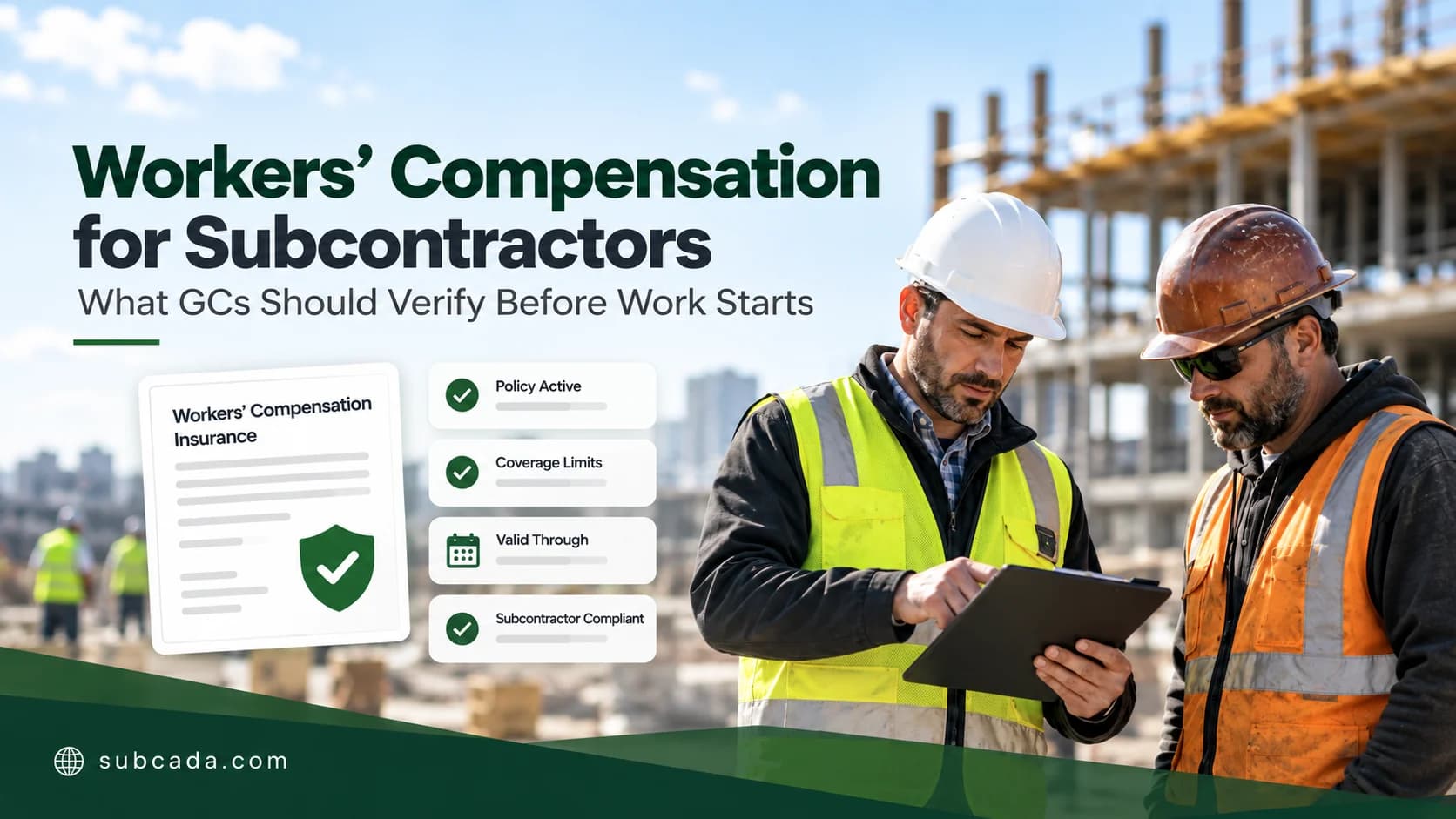
Workers’ Compensation for Subcontractors: What GCs Should Verify Before Work Starts
Workers’ compensation is one of the most important—and most state-specific—parts of subcontractor insurance compliance. A subcontractor may hand a general contractor a certificate showing workers’ compensation coverage, but the GC still needs a repeatable process for checking whether the documentation matches the project requirement and stays current while work is underway.
The key point is that there is no single nationwide rule that tells every GC exactly what every subcontractor must carry. Workers’ compensation requirements, exemptions, verification systems, and contractor liability rules vary by state and by the facts of the working relationship. Contract requirements can also be stricter than statutory minimums.
This guide explains a practical compliance workflow for GCs. It is not legal or insurance advice; project teams should confirm requirements with their broker, counsel, and the workers’ compensation authority in the state where the work occurs.
Why workers’ compensation belongs in subcontractor compliance
Workers’ compensation generally provides statutory benefits for employees who suffer work-related injuries or illnesses. For a GC, the compliance question is not simply whether a subcontractor says it is insured. The GC needs to know what evidence its contract and risk program require, whether that evidence is current, and what to do when a subcontractor claims an exemption.
State rules can create meaningful consequences when subcontractor coverage is missing. For example, the New York State Insurance Fund tells policyholders to verify subcontractor coverage and says contractors should obtain a workers’ compensation certificate before work starts and annually thereafter. See NYSIF’s subcontractor coverage guidance.
That is a New York example, not a universal rule. It illustrates why a GC should build its workflow around the applicable jurisdiction rather than copying a generic internet checklist.
What should a GC collect?
Depending on the state, contract, and project, the compliance file may include:
| Item | What the GC is trying to confirm |
|---|---|
| Certificate or state-prescribed proof of coverage | Evidence of the required workers’ compensation policy |
| Named insured | The insured business corresponds to the subcontracting entity |
| Policy number | A traceable policy reference is present |
| Effective and expiration dates | Coverage period aligns with the required work period |
| Employer’s liability limits | Contract-required limits are shown where applicable |
| State/jurisdiction information | Coverage documentation is appropriate for the work location |
| Exemption documentation | A claimed exemption is supported by the documentation required by the jurisdiction/project |
| Renewal certificate | Coverage remains documented after expiration |
A Certificate of Insurance is often part of the file, but the exact evidence required for workers’ compensation can differ by state. Some jurisdictions have official verification tools or prescribed certificate forms.
Workers’ compensation vs. employer’s liability
These terms are related but should not be treated as interchangeable.
Workers’ compensation is the statutory portion of the policy. Employer’s liability generally addresses certain employee injury claims outside the benefits payable under workers’ compensation law, subject to the policy’s terms and exclusions.
Many construction contracts specify employer’s liability limits in addition to requiring statutory workers’ compensation. A compliance reviewer should therefore compare the submitted documentation against the actual subcontract instead of merely checking that a workers’ compensation box appears on a COI.
How to review a subcontractor’s workers’ compensation documentation
1. Match the business identity
Compare the named insured with the legal entity on the subcontract, W-9, and vendor record. A trade name, affiliate, or similarly named company should not automatically be assumed to be the contracting entity.
SubCada’s W-9 guide explains why consistent vendor identity matters across compliance documents.
2. Check the coverage period
Record the effective and expiration dates. If the policy expires during the project, create a renewal requirement before the expiration date rather than discovering the gap after the fact.
3. Compare the documentation with the contract
Do not substitute a generic company standard for the signed project requirement. Review applicable employer’s liability limits, special project provisions, and any required waiver of subrogation.
If the subcontract requires a waiver, see What Is a Waiver of Subrogation in Construction Insurance?.
4. Confirm state-specific requirements
Workers’ compensation is heavily jurisdiction-dependent. Determine whether the state provides an official coverage lookup, exemption certificate, registration, or other verification mechanism. Document which source was checked and when.
5. Treat exemptions as a separate workflow
A subcontractor saying “I have no employees” is not itself a compliance document. Whether an owner, sole proprietor, partner, member, or other individual can be excluded or exempt depends on applicable law and circumstances.
Create a defined status such as exemption pending review rather than marking the subcontractor compliant based on an email statement. Collect whatever official documentation your jurisdiction and risk program require.
6. Record the reviewer and decision
An audit-ready record should show what was received, when it was reviewed, who reviewed it, and any exception that was approved.
Why a COI alone may not finish the review
A COI is useful evidence, but it is a summary document. The ACORD certificate itself is informational and does not replace the policy or automatically create rights. A GC may need additional documentation when the contract requires endorsements or when state-specific workers’ compensation proof is prescribed.
The practical workflow is therefore:
- Receive the required document.
- Extract the relevant policy information.
- Compare it with the project requirement.
- Verify through an appropriate source when required by policy or jurisdiction.
- Track expiration.
- Resolve exceptions before approval.
What if the subcontractor says it is exempt?
Do not assume that “exempt” means the same thing in every state. Ask four questions:
- What exemption is being claimed?
- Which jurisdiction applies?
- What official evidence supports the claim?
- Does the subcontract still require coverage even if the subcontractor is legally eligible for an exemption?
A contract can impose insurance requirements that are different from a statutory threshold, subject to applicable law. That is why compliance teams should separate legal eligibility for an exemption from satisfaction of the project’s contractual requirement.
Common workers’ compensation compliance mistakes
Accepting expired evidence
A valid document at onboarding can become stale halfway through the job. Expiration monitoring is part of compliance, not an optional administrative step.
Mixing entities
Coverage issued to one company should not automatically be applied to another related company.
Treating every exemption the same
State rules differ. Maintain jurisdiction-specific instructions rather than a universal “no employees” checkbox.
Forgetting employer’s liability
If the subcontract specifies employer’s liability limits, review those limits separately.
Keeping renewals only in email
When certificates and exemption records live in individual inboxes, project teams can easily work from different versions.
A practical GC checklist
Before work begins, confirm as applicable:
- [ ] Contracting entity matches the documentation
- [ ] Required workers’ compensation evidence is on file
- [ ] Policy effective date is recorded
- [ ] Policy expiration date is recorded
- [ ] Employer’s liability limits meet the subcontract requirement
- [ ] Applicable state verification has been completed where required by your process
- [ ] Any exemption has supporting documentation
- [ ] Waiver of subrogation has been reviewed if contractually required
- [ ] Exceptions have an identified approver
- [ ] Renewal reminders are scheduled
- [ ] Review history is retained
How workers’ compensation fits with the rest of insurance compliance
Workers’ compensation is only one line in a subcontractor insurance program. GCs commonly track commercial general liability, auto liability, umbrella/excess, and project- or trade-specific coverage as well.
See SubCada’s subcontractor insurance requirements by trade for a broader framework. Requirements should always be based on the contract and professional risk guidance rather than copied blindly from another project.
Managing renewals without spreadsheet chasing
The administrative problem becomes obvious when a GC has dozens or hundreds of subcontractors. One policy expires next week, another exemption needs review, and a third subcontractor has uploaded a replacement certificate that only one project manager has seen.
SubCada helps construction teams keep subcontractor requirements, documents, expiration dates, reminders, and review status in one workflow. The purpose is not to make legal coverage decisions automatically. It is to make it easier for the responsible people to see what is current, what is missing, and what needs review.
Frequently asked questions
Does every subcontractor need workers’ compensation insurance?
There is no single answer for every U.S. project. Requirements depend on state law, business structure, employees, project circumstances, and contract terms. Confirm the applicable rules for the state where the work occurs.
Is a workers’ compensation COI enough?
It may be part of the required evidence, but the appropriate proof and verification process depends on the jurisdiction, contract, and GC risk program. Some states provide official verification systems or prescribed forms.
What should a GC do when coverage expires during a project?
Follow the project’s documented escalation process. Request updated evidence before expiration and route any unresolved gap to the person authorized to decide whether work can continue.
Should workers’ compensation documents be collected every year?
Renewal should be tracked whenever the required evidence expires. Some organizations also perform annual vendor reviews. The correct cadence should reflect the policy period, project duration, jurisdiction, and company procedures.
Bottom line
A strong subcontractor workers’ compensation process does more than collect a certificate once. It matches the insured entity, checks dates and required limits, handles exemptions deliberately, follows jurisdiction-specific verification rules, tracks renewals, and preserves the review history.
For GCs, that turns workers’ compensation from an inbox task into a controlled compliance workflow—and makes it much easier to see a gap before it becomes a project problem.