
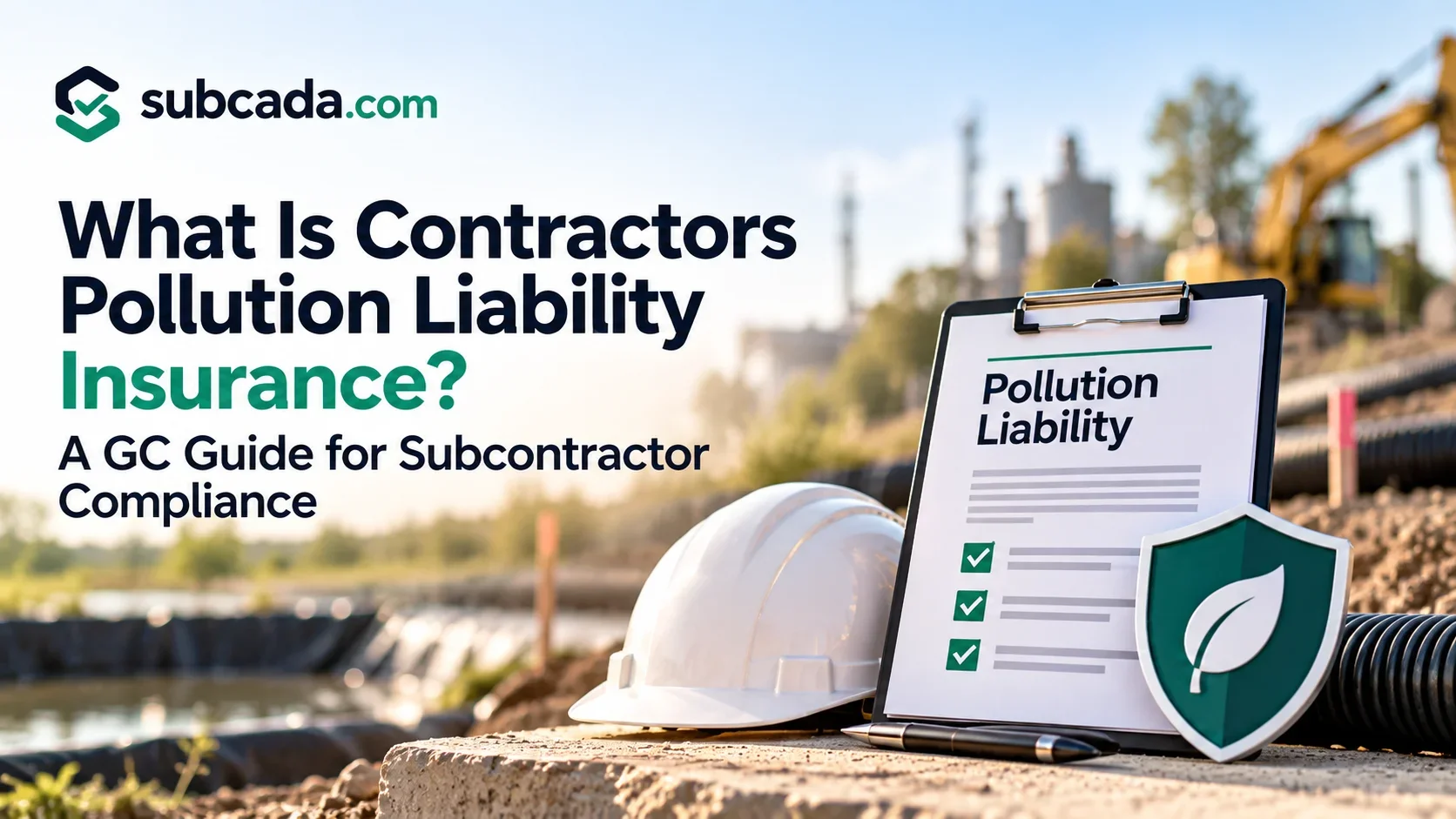
What Is Contractors Pollution Liability Insurance? A GC Guide for Subcontractor Compliance
General liability insurance is familiar territory for most construction teams. Contractors Pollution Liability (CPL) is less familiar, yet it can become an important project requirement when subcontractor operations create environmental exposures that ordinary liability programs may not address in the same way.
CPL is not automatically required for every subcontractor. Whether it is appropriate depends on the scope of work, contract, site conditions, owner requirements, and the insurance program designed for the project. When it is required, however, the GC needs more than a spreadsheet cell saying “pollution—yes.” The team needs to understand what document was submitted, what period it covers, what operations are involved, and what project-specific terms need professional review.
This guide provides a compliance framework, not coverage or legal advice. Pollution policies vary significantly, so GCs should rely on their broker, risk manager, counsel, and project documents for actual coverage decisions.
What is Contractors Pollution Liability insurance?
Contractors Pollution Liability is environmental liability coverage designed for pollution conditions arising from contracting operations. Depending on the policy, coverage can address liabilities such as bodily injury, property damage, cleanup costs, defense costs, and certain transportation or disposal-site exposures.
Policy forms are not uniform. CPL can be written on an occurrence or claims-made basis and may be annual, project-specific, or structured in other ways. That makes document review especially important.
Starr describes contractor pollution coverage as addressing environmental liabilities resulting from pollution incidents at job sites and notes that coverage may be offered on occurrence or claims-made forms. See Starr’s contractor pollution overview.
Why can construction work create pollution exposure?
“Pollution” in construction is broader than a dramatic hazardous-waste spill. Depending on the work and policy language, environmental exposures can arise from operations involving fuels, chemicals, contaminated soil, mold or microbial matter, asbestos, lead, solvents, coatings, refrigerants, demolition debris, or runoff.
The relevant exposure depends on the actual scope and site. Excavation on a previously developed parcel raises different questions from HVAC work in an occupied hospital or demolition in an older building.
That is why CPL requirements are often scope-specific, not a generic requirement copied onto every trade.
Which subcontractors may be asked to carry CPL?
There is no universal list, but project teams commonly evaluate pollution coverage for scopes such as:
- Environmental remediation and abatement
- Demolition
- Excavation and underground work
- Fuel or chemical handling
- Painting and coatings
- Roofing operations involving certain chemicals or materials
- Mechanical/HVAC operations with refrigerants
- Plumbing and water-related environmental exposures
- Concrete or site work with runoff concerns
- Waste hauling or transportation connected to pollutants
The contract and risk assessment control. A low-risk scope on one project may have a different requirement on another project because of site history, nearby property, waterways, occupied facilities, or owner specifications.
CPL vs. commercial general liability
A GC should not assume that a subcontractor’s Commercial General Liability policy makes a CPL requirement unnecessary.
CGL and CPL are different coverage tools. General liability policies can contain pollution exclusions and exceptions whose effect depends on the wording and facts. CPL is designed specifically for environmental liability exposures.
The compliance takeaway is simple: if the subcontract requires CPL, verify CPL. Do not mark the requirement satisfied merely because the COI shows a general liability policy.
For the fundamentals of reading insurance evidence, start with What Is a Certificate of Insurance?.
What should a GC review when CPL is required?
1. Named insured
Confirm the insured entity corresponds to the subcontractor that signed the contract. Related companies should not be assumed to share coverage.
2. Policy period
Record effective and expiration dates. If the policy is claims-made, timing questions can be more complicated than simply checking whether the policy is active today.
3. Limits
Compare the submitted limits with the actual subcontract or project insurance exhibit. Do not use an internet “standard limit” as a substitute for the signed requirement.
4. Covered operations
A certificate may show that a pollution policy exists without proving that every operation, pollutant, location, or project is covered. Material questions should be escalated to the GC’s insurance professional.
5. Claims-made details when applicable
Claims-made coverage can involve retroactive dates and extended reporting considerations. If the project specification includes those requirements, track the supporting evidence and route interpretation to the broker or risk manager.
6. Additional insured requirements
Some contracts require upstream parties to be included as additional insureds on CPL. Whether and how that can be accomplished depends on the policy. Collect the actual evidence required by the contract rather than relying on a description typed onto a certificate.
7. Primary/noncontributory and waiver requirements
If these provisions are required for the pollution policy, verify the applicable endorsement or policy evidence with your insurance professional. SubCada has separate explainers for primary and noncontributory insurance and waivers of subrogation.
8. Transportation and disposal exposure
If a subcontractor transports pollutants or waste or uses disposal facilities, the project may require specific coverage. Do not assume base CPL wording automatically satisfies those requirements.
Occurrence vs. claims-made CPL
This distinction matters because the trigger for coverage differs.
An occurrence form generally focuses on when the covered pollution event occurs, subject to policy wording. Claims-made forms generally require attention to when a claim is made and may include a retroactive date. The exact mechanics vary by policy.
For compliance teams, this means the database may need more than “expiration date.” Where required by the project, it may also need a field or review note for the retroactive date and any required completed-operations or extended-reporting period.
Do not interpret those provisions without qualified insurance guidance.
Project-specific vs. practice/annual policies
A subcontractor may carry an annual CPL policy covering its contracting operations, while a project may require dedicated coverage or project-specific terms. Both can be legitimate structures, but they are not automatically interchangeable.
A GC should compare:
| Question | Why it matters |
|---|---|
| Is the policy annual or project-specific? | Establishes the coverage structure |
| Does the project fall within the covered operations/territory? | Helps identify obvious mismatches |
| What limits does the contract require? | Prevents approval based on insufficient limits |
| Is the policy claims-made? | May trigger retroactive/reporting review |
| Are required upstream parties addressed? | Supports contractual risk-transfer review |
| Are transportation/disposal exposures relevant? | Can identify additional coverage questions |
Common CPL compliance mistakes
Assuming “pollution” only means hazardous-waste contractors
Environmental exposure can arise in ordinary construction trades. Requirements should follow the project’s risk assessment and contract.
Accepting CGL in place of CPL
If the contract separately requires CPL, a general liability line does not automatically satisfy it.
Ignoring the policy form
Occurrence and claims-made structures can create different review questions.
Tracking only the expiration date
Project requirements may include retroactive dates, completed-operations periods, additional insured provisions, or other terms that need review.
Treating the COI description box as the policy
A certificate summarizes insurance. It does not rewrite policy terms.
A practical CPL compliance checklist
When the subcontract requires pollution coverage, confirm as applicable:
- [ ] Correct subcontractor legal entity
- [ ] CPL policy identified
- [ ] Effective and expiration dates recorded
- [ ] Required limits compared with the subcontract
- [ ] Claims-made or occurrence basis identified when relevant
- [ ] Retroactive date reviewed if required
- [ ] Project/scope applicability reviewed
- [ ] Additional insured evidence collected if required
- [ ] Primary/noncontributory evidence reviewed if required
- [ ] Waiver of subrogation evidence reviewed if required
- [ ] Transportation/disposal requirements reviewed where relevant
- [ ] Exceptions routed to a qualified reviewer
- [ ] Renewal or continuing-coverage requirement tracked
How CPL fits into trade-specific insurance requirements
Pollution coverage is a good example of why one insurance checklist should not necessarily be applied to every subcontractor. An electrical subcontractor performing routine interior work may present a very different environmental exposure from an abatement contractor removing asbestos-containing materials.
SubCada’s insurance requirements by trade guide explains how GCs can organize requirement profiles around actual scopes instead of using a one-size-fits-all checklist.
Managing CPL documentation with SubCada
Specialty insurance requirements are easy to lose when they live in a project manager’s inbox. A GC may have standard GL and workers’ compensation documents for every subcontractor but only require CPL from a subset of trades on certain projects.
SubCada helps teams assign project-specific requirements, collect documents, track expiration dates, and see unresolved items in one place. A risk professional still decides whether the coverage is acceptable; the software helps make sure the requirement and evidence do not disappear in email.
Frequently asked questions
Is Contractors Pollution Liability required for every subcontractor?
No universal rule requires every subcontractor to carry CPL. Requirements depend on the contract, scope, site, owner, jurisdiction, and risk program.
Is CPL the same as general liability?
No. CPL is designed for environmental/pollution liability exposures. General liability and CPL can work alongside each other, but their terms and exclusions differ.
Can CPL be claims-made?
Yes. Contractor pollution coverage can be offered on claims-made or occurrence forms. The form should be identified and reviewed against project requirements.
Should a GC rely only on the COI?
A COI is a useful summary, but project requirements may call for endorsements, policy evidence, or professional verification beyond the certificate.
Bottom line
Contractors Pollution Liability is a specialized coverage that becomes important when a subcontractor’s operations create environmental exposure or the contract specifically requires it. For GCs, the compliance job is to identify which trades and projects require CPL, collect the right evidence, compare it with the contract, track time-sensitive requirements, and escalate coverage questions to qualified professionals.
That structured approach is far safer than a generic “COI received” checkbox—and much easier to manage when specialty requirements are tied directly to each subcontractor and project.
This article is general informational content and is not legal, insurance, financial, accounting, or surety advice. Bonding requirements and underwriting decisions vary by surety, contract, project, jurisdiction, and subcontractor. Consult the applicable surety and qualified professionals for project-specific decisions.