
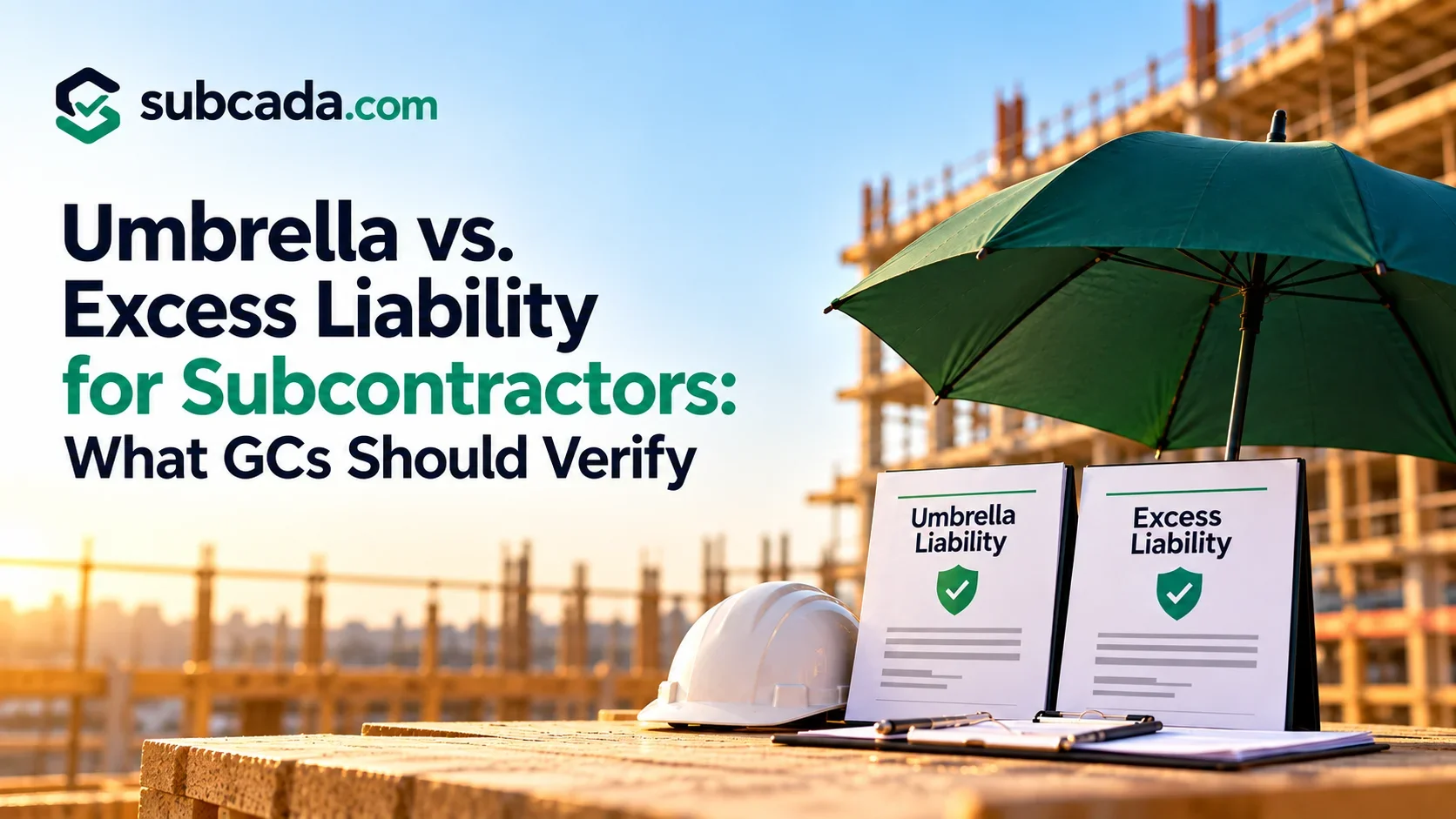
Umbrella vs. Excess Liability for Subcontractors: What GCs Should Verify
A subcontractor's commercial general liability policy may show a $1 million per-occurrence limit while the subcontract requires a higher total liability limit. The certificate may then list another policy under Umbrella Liability or Excess Liability.
For a general contractor, seeing an extra limit on the COI is only the beginning. The real questions are: What underlying policies does the upper layer sit over? Does it provide the coverage required by the subcontract? Do additional insured requirements extend into that layer? Are the dates and limits aligned?
This guide explains umbrella and excess liability from a practical subcontractor-compliance perspective. Exact coverage depends on the policies and endorsements, so questions about a specific program should be reviewed with qualified insurance professionals.
What is excess liability insurance?
Excess liability insurance generally provides an additional layer of liability limits above specified underlying insurance. Once the applicable underlying limit is exhausted by a covered loss, the excess layer may respond according to its own terms, conditions, exclusions, attachment point, and limits.
A simple illustration:
- Subcontractor CGL: $1 million per occurrence
- Applicable excess layer: $4 million
- Potential combined limit for a covered claim: $5 million
That example is deliberately simplified. Whether the excess policy actually responds depends on the policies, endorsements, loss, and underlying coverage.
What is umbrella liability insurance?
A commercial umbrella is also designed to provide liability limits above underlying policies. Umbrella policies are often written over more than one underlying liability line, such as general liability, automobile liability, and employers liability.
The word “umbrella,” however, should not be treated as proof that the policy automatically follows every term of every underlying policy. Policy forms differ.
That is why a GC's compliance team should verify the contract requirement and supporting documentation instead of relying on the label printed on a certificate.
Umbrella vs. excess liability: are they the same?
The terms are sometimes used loosely in construction documents, but they should not automatically be treated as identical.
An excess policy may be written to provide limits above a specific underlying policy or schedule of policies. An umbrella may sit over multiple underlying liability lines and may have broader features in some programs. In either case, actual policy wording controls.
From a GC compliance standpoint, the safest operational question is not “Is umbrella better than excess?” It is:
Does the subcontractor's actual insurance program satisfy the project's required limits, underlying coverage, insured status, and other contractual conditions?
Why do construction contracts require an umbrella or excess layer?
Primary liability limits can be lower than the limits required for a larger or higher-risk project. An umbrella or excess policy can provide additional capacity above those primary limits.
Construction contract guidance recognizes umbrella/excess insurance as a risk-management choice tied to project requirements. For example, the Engineers Joint Contract Documents Committee's supplementary-condition guidance discusses whether owners should require umbrella/excess liability and how it relates to primary commercial general liability limits. See ASCE's EJCDC supplementary conditions guidance.
Actual required limits should come from the contract, owner requirements, project risk analysis, and insurance advice—not from a generic online table.
Where does umbrella/excess appear on a COI?
On an ACORD-style certificate, umbrella/excess liability typically appears as a separate coverage section with its own policy number, effective date, expiration date, and limits.
A reviewer may see fields such as:
- Occurrence limit
- Aggregate limit
- Claims-made or occurrence indicator
- Deductible or retention indicator
- Policy number
- Effective and expiration dates
A certificate is evidence of reported insurance information; it does not replace the policy or endorsements. If the subcontract requires specific coverage wording or additional insured treatment, the GC may need supporting endorsements or policy documentation according to its insurance-review process.
For the fundamentals, see SubCada's Certificate of Insurance guide.
What should a GC verify on subcontractor umbrella or excess coverage?
1. Required limit
Start with the subcontract. If the contract requires a specific umbrella/excess limit, compare that requirement with the certificate and supporting documents.
Do not create a universal company rule from a blog post. Required limits vary by project, trade, owner, jurisdiction, and risk profile.
2. Effective and expiration dates
Confirm the policy is effective for the required period. A subcontractor can have a current CGL but an expired umbrella, creating a gap against the contractual limit requirement.
This is one reason tracking only a single “COI expiration date” can be misleading. Different policies on the same certificate may have different dates.
3. Underlying policies
Determine which policies the umbrella/excess coverage sits over when that matters to the contract. A requirement may contemplate excess limits over CGL, auto, and employers liability, while the actual policy structure may differ.
This often requires information beyond the face of the certificate.
4. Additional insured treatment
If the subcontract requires the GC, owner, or another upstream party to receive additional insured protection, confirm how that requirement applies to the umbrella/excess layer.
Do not assume additional insured status on the primary CGL automatically answers the umbrella question.
SubCada's guide to CG 20 10 vs. CG 20 37 explains ongoing and completed-operations additional insured concepts at the CGL level.
5. Primary and noncontributory requirement
If the contract requires primary and noncontributory treatment, the insurance reviewer should determine what documentation is needed and whether the requirement extends to the applicable layers.
See Primary and Noncontributory Insurance in Construction.
6. Waiver of subrogation
If the subcontract requires a waiver of subrogation, confirm which policies must contain it and obtain the documentation required by your insurance program. A certificate notation by itself may not establish that an endorsement has changed the policy.
See SubCada's waiver of subrogation guide.
7. Aggregate limits
Check both occurrence and aggregate limits where applicable. A large occurrence limit does not tell the reviewer how much aggregate limit remains or how the aggregate applies across work.
8. Policy form and exclusions when required
Some projects require review by a broker, risk manager, or counsel because the contract specifies particular forms, coverage breadth, exclusions, or follow-form treatment. Compliance staff should know when a document can be administratively checked and when it needs professional insurance review.
Example: matching a subcontract requirement
Assume a subcontract requires:
- $1 million CGL per occurrence
- $2 million CGL aggregate
- $1 million auto liability
- $5 million umbrella/excess liability
- GC and owner additional insured where specified
- primary and noncontributory treatment where specified
The subcontractor sends a certificate showing a $5 million umbrella. It is tempting to mark the requirement complete immediately.
A better workflow asks:
- Is the umbrella current?
- Are the policy dates aligned with the work period?
- Does the $5 million limit match the contract?
- What underlying policies are scheduled?
- Are required additional insured and other risk-transfer provisions supported by the necessary documentation?
- Is professional review required by company policy?
The certificate starts the review; it does not necessarily finish it.
Umbrella/excess vs. CGL
CGL and umbrella/excess coverage play different roles.
Commercial General Liability is a primary liability policy for covered third-party bodily injury, property damage, and other covered liability exposures subject to its terms.
Umbrella/excess liability provides an additional layer of limits above designated underlying coverage, subject to the upper policy's terms.
A subcontractor generally cannot replace required primary CGL simply by showing a large umbrella number. The contract should identify the required structure.
Umbrella/excess vs. professional liability
Professional liability addresses professional-services exposures, such as certain design or engineering errors, subject to the policy. An umbrella over general liability does not automatically create professional liability coverage.
If a design-build or design-assist subcontractor has professional responsibility, the GC should separately track any professional liability requirement stated in the contract.
Umbrella/excess vs. pollution liability
Pollution liability is another specialized coverage category. An umbrella number should not be assumed to solve a pollution-coverage requirement. Trades involving environmental remediation, hazardous materials, fuel systems, or other pollution exposures may have separate contractual requirements.
SubCada's insurance requirements by trade guide explains why specialty exposures should be tied to scope rather than a one-size-fits-all checklist.
Common umbrella/excess compliance mistakes
Tracking only the CGL expiration date
A certificate can list multiple policies with different dates. Each required coverage should be tracked independently when the dates differ.
Assuming the word “umbrella” proves follow-form coverage
The label is not enough. If follow-form treatment is contractually important, route the policy or endorsement for appropriate review.
Checking only the total dollar amount
A $5 million number does not tell you what sits underneath it, which entities receive insured status, or what exclusions apply.
Assuming certificate wording changes the policy
Certificates summarize insurance information. Contractual requirements that depend on policy wording generally need the appropriate endorsement or policy evidence.
Using the same limit for every project without analysis
Limits should reflect actual contractual and risk requirements. Different owners and projects can impose different limits on the same subcontractor.
A practical GC checklist
For each required umbrella/excess policy, track:
- [ ] Carrier
- [ ] Policy number
- [ ] Effective date
- [ ] Expiration date
- [ ] Per-occurrence limit
- [ ] Aggregate limit where applicable
- [ ] Required underlying policies
- [ ] Required additional insured evidence
- [ ] Primary/noncontributory requirement if applicable
- [ ] Waiver requirement if applicable
- [ ] Supporting endorsements received
- [ ] Reviewer and review date
- [ ] Exception or deficiency notes
- [ ] Renewal follow-up date
Why spreadsheets struggle with layered insurance requirements
A spreadsheet often gives each subcontractor one row and one expiration-date column. Real insurance programs are more complicated.
One subcontractor can have CGL, workers compensation, auto, umbrella, professional liability, and pollution policies with different dates and project-specific requirements. The same subcontractor may be compliant on one project and deficient on another because the owner requires different limits.
That is why scalable compliance tracking separates the subcontractor, the document, the requirement, the project, and the expiration date.
SubCada's guide to tracking subcontractor compliance across multiple projects explains this model in more detail.
Managing umbrella/excess requirements with SubCada
SubCada gives GCs a structured place to track required subcontractor documents and expiration dates instead of relying on email threads and one-cell spreadsheet statuses. Teams can see what has been received, what is approaching expiration, and what still requires follow-up.
Insurance decisions still belong with the appropriate insurance and risk professionals. The software's job is to make the workflow visible and repeatable.
Frequently asked questions
Is umbrella insurance required for every subcontractor?
No universal rule requires the same umbrella policy for every subcontractor. Requirements depend on contracts, project specifications, owner requirements, scope, jurisdiction, and risk-management decisions.
Can excess liability satisfy an umbrella requirement?
Possibly, depending on the contract and the actual policy. The terms are not automatically interchangeable. Have the appropriate insurance professional review the specific requirement and coverage.
Does umbrella insurance automatically include additional insured coverage?
Do not assume it does. Review the actual policy/endorsement structure and contractual requirement.
Should umbrella expiration be tracked separately from CGL?
Yes when the dates differ or when the policy is a distinct required compliance item. A current CGL does not prove that a required upper layer is current.
Bottom line
Umbrella and excess liability can provide the higher liability limits a construction contract requires, but a large number on a COI is not enough by itself. GCs should match the policy to the contract, verify dates and limits, understand the underlying structure, collect required endorsements, and document the review.
That turns “$5M umbrella” from a checkbox into a defensible compliance workflow.
This article is general informational content and is not legal, insurance, financial, accounting, or surety advice. Bonding requirements and underwriting decisions vary by surety, contract, project, jurisdiction, and subcontractor. Consult the applicable surety and qualified professionals for project-specific decisions.