
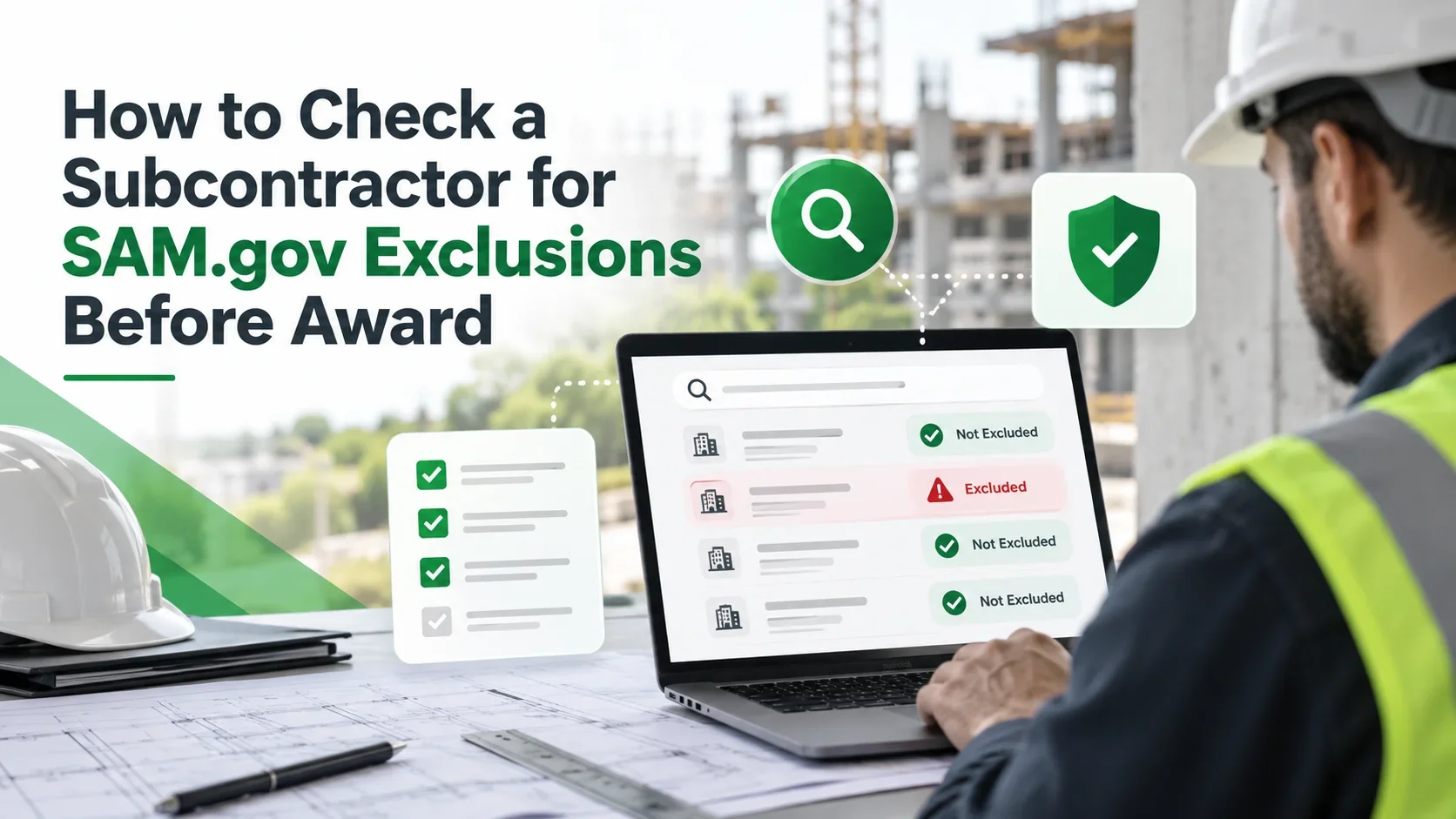
How to Check a Subcontractor for SAM.gov Exclusions Before Award
For a private construction project, a general contractor may prequalify a subcontractor using licenses, insurance, safety records, financial information, references, and capacity. On a federal contract, another question can become important: is the proposed subcontractor debarred, suspended, proposed for debarment, or otherwise excluded from federal contracting?
The federal System for Award Management, or SAM.gov, contains exclusion records used in federal procurement. Depending on the prime contract, subcontract value, tier, and applicable Federal Acquisition Regulation clauses, an exclusion can restrict subcontracting or trigger disclosure and notification obligations.
This guide explains the basic compliance workflow for GCs and federal prime contractors. It is educational, not legal advice; federal contracting requirements should be reviewed against the actual solicitation, prime contract, current FAR, agency rules, and counsel when necessary.
What is a SAM.gov exclusion?
SAM.gov is the federal government's System for Award Management. Among its functions, it provides records concerning entities and individuals that are excluded from certain federal transactions.
Federal Acquisition Regulation (FAR) Subpart 9.4 covers debarment, suspension, and ineligibility. FAR 9.405 explains the effect of listing and states that contractors that are debarred, suspended, proposed for debarment, or voluntarily excluded are generally excluded from receiving federal contracts and, in applicable circumstances, subcontracts unless the required compelling-reason determination is made.
See the current FAR Part 9 on Acquisition.gov and SAM.gov.
Why should a GC check SAM exclusions?
If a construction company is performing a federal prime contract, the prime contract may include FAR 52.209-6, Protecting the Government's Interest When Subcontracting With Contractors Debarred, Suspended, Proposed for Debarment, or Voluntarily Excluded.
The current clause requires, for covered subcontracts above the applicable FAR threshold and excluding qualifying commercially available off-the-shelf items, disclosure concerning whether the proposed subcontractor or its principals are debarred, suspended, proposed for debarment, or voluntarily excluded. The clause also addresses notification and flow-down requirements.
The exact obligations depend on the contract and current rules. A GC should therefore avoid turning this into a universal private-project checklist.
What does FAR 9.405-2 say about subcontracting restrictions?
As of September 2026, Acquisition.gov's current FAR 9.405-2 states that contractors are prohibited from entering into certain subcontracts in excess of $45,000 with a contractor that is debarred, suspended, proposed for debarment, or voluntarily excluded unless there is a compelling reason to do so. The rule contains exceptions and related notification requirements, including treatment of commercially available off-the-shelf items.
Because federal thresholds and regulations can change, do not hard-code the dollar amount into a permanent internal policy without a process for checking the current FAR. Use the current official text at FAR 9.405-2 when applying the rule.
What is FAR 52.209-6?
FAR 52.209-6 is a contract clause designed to protect the federal government's interests when a prime contractor subcontracts with excluded parties.
The current clause states, among other things, that a contractor must require certain proposed subcontractors above the applicable threshold to disclose in writing whether the subcontractor or its principals are or are not debarred, suspended, proposed for debarment, or voluntarily excluded by the federal government.
It also requires written notice to the contracting officer before entering into certain covered subcontracts with an excluded party and describes information that notice must contain.
For non-commercial-products/services contracts, the clause also contains a flow-down requirement for certain subcontracts.
Read the current official clause at Acquisition.gov FAR 52.209-6.
Does every GC need to check every subcontractor in SAM.gov?
Not because of FAR 52.209-6 alone.
A private GC building a privately financed project is not automatically subject to federal procurement rules simply because SAM.gov exists. Federal, federally assisted, state, local, owner-specific, and private projects can have different eligibility requirements.
The correct workflow starts with the contract:
- Identify whether the project is federal or contains federal requirements.
- Review the prime contract and incorporated clauses.
- Identify the applicable subcontract threshold and exceptions.
- Determine which tiers are covered.
- Follow any agency-specific requirements.
- Document the check required by your contract and compliance program.
When the contract is unclear, route the question to the appropriate contracts or legal professional.
How to check a proposed subcontractor in SAM.gov
Step 1: Collect accurate identity information
Before searching, collect enough information to distinguish the subcontractor from similarly named companies. Useful identifiers may include:
- Exact legal business name
- DBA, if relevant
- Physical address
- Unique Entity ID (UEI), when available/relevant
- Names of principals when required by the applicable clause or process
A name-only search can produce false matches or miss a record if the company operates under a different name.
Step 2: Use the official SAM.gov exclusion search
Use SAM.gov rather than relying solely on a third-party list. Search the relevant exclusion records using the identifiers available to you.
The goal is not merely to take a screenshot of “no results.” The reviewer should make sure the search corresponds to the correct entity.
Step 3: Review any possible match carefully
If a result appears, compare identifying information. Do not assume two companies with similar names are the same entity.
Review the record's exclusion type, status, agency, dates, and other official details. Acquisition.gov directs inquiries concerning listed contractors and entities to the agency or authority that took the action when clarification is needed.
Step 4: Do not make an unsupported eligibility decision
An active exclusion can have significant contracting consequences, but the exact effect depends on the applicable rule, transaction, and contract. Escalate a possible match to the person responsible for federal contracts, compliance, or legal review.
Step 5: Document the check
A useful audit record can include:
- Subcontractor legal name searched
- UEI or other identifier used, if applicable
- Date and time of search
- Person who performed the check
- Result
- SAM record/reference information for a match
- Screenshot or exported evidence if your policy requires it
- Escalation notes
- Final approval/exception decision
Step 6: Recheck when your process requires it
A status can change after initial prequalification. Your prime contract, company policy, or award workflow may call for another check immediately before subcontract award or at another point.
Do not assume a search performed months earlier answers the question forever.
What if the subcontractor has an active exclusion?
Do not simply delete the record or proceed as normal.
FAR 9.405 and 9.405-2 describe the effect of exclusions and restrictions on subcontracting. For covered situations, doing business with an excluded subcontractor can require a compelling reason and notification or approval steps.
The correct response is to:
- Stop the normal approval workflow.
- Verify that the SAM match is actually the proposed subcontractor or principal.
- Identify the applicable prime-contract clause and FAR provision.
- Escalate to the contracting/compliance/legal team.
- Document the decision and any required notice.
A compliance-management system should flag the exception; it should not independently make the legal determination.
Debarred vs. suspended vs. proposed for debarment
These terms are related but not identical.
Debarment is an exclusion imposed after the applicable process for a specified cause and period.
Suspension is generally a temporary action used pending investigation or proceedings when the regulatory standard is met.
Proposed for debarment indicates that debarment has been proposed and can have procurement consequences during the pending period.
Voluntarily excluded can also be covered by current FAR subcontracting provisions.
For exact definitions and effects, use current FAR Subpart 9.4 rather than relying on shorthand descriptions.
SAM exclusion check vs. contractor license verification
These are completely different checks.
A state contractor-license lookup asks whether a company holds a required credential and what its status is under the relevant licensing authority.
A SAM exclusion search asks whether the entity or person has an exclusion record relevant to federal transactions.
A subcontractor can have an active state license and still have a federal exclusion issue, or vice versa.
See SubCada's guide on how to verify a subcontractor's license for the licensing workflow.
SAM exclusion check vs. subcontractor prequalification
SAM is also not a replacement for normal prequalification. It does not answer whether a subcontractor has:
- Adequate project experience
- Current insurance
- Acceptable safety information
- Sufficient financial capacity
- Available crews
- Required licenses
- Appropriate bonding capacity
- Strong references
Those questions belong in a broader qualification process. See Subcontractor Prequalification: What to Check Before You Hire.
Common SAM.gov compliance mistakes
Treating a name match as definitive
Similar company names are common. Verify identifiers before concluding that a record belongs to your subcontractor.
Searching a third-party database instead of the official system
Third-party tools may be useful operationally, but the authoritative federal record should be checked when the requirement calls for SAM exclusions.
Assuming the rule applies to every subcontract
Thresholds, COTS exceptions, contract clauses, transaction type, and subcontract tier matter. Read the actual prime contract and current FAR.
Saving no evidence of the review
If a project is later audited, a team may need to show what it checked and when. An undocumented verbal confirmation is difficult to reconstruct.
Checking once during vendor setup and never again
Vendor onboarding and subcontract award can occur months apart. Design the workflow around the points at which your contract requires verification.
Hard-coding old FAR thresholds
The applicable threshold has changed over time. Use the current official FAR and maintain version-aware procedures rather than copying an old number indefinitely.
A practical SAM exclusion review checklist
For covered federal work, a GC's internal checklist may include:
- [ ] Confirm federal/contractual applicability
- [ ] Identify applicable FAR clause
- [ ] Confirm current subcontract threshold
- [ ] Confirm any COTS or other exception
- [ ] Collect subcontractor legal name and identifiers
- [ ] Search official SAM.gov exclusions
- [ ] Review possible matches carefully
- [ ] Check required principal disclosures
- [ ] Record search date and reviewer
- [ ] Save evidence according to company policy
- [ ] Escalate any active or uncertain match
- [ ] Complete required contracting-officer notice if applicable
- [ ] Apply required clause flow-downs
- [ ] Recheck at award if required
How this fits into subcontractor compliance management
Federal-project compliance is rarely one document. A GC may need to manage insurance, licenses, W-9s, safety records, contract clauses, eligibility checks, certifications, and project-specific documents for the same subcontractor.
The challenge is maintaining evidence that each requirement was completed at the right time.
SubCada's multi-project subcontractor compliance guide explains why company-level records and project-specific requirements need to be separated but connected.
Managing eligibility evidence with SubCada
SubCada helps GCs centralize subcontractor requirements, documents, status, and follow-up. For a federal-project workflow, an organization can treat required exclusion-check evidence as another project-specific compliance item alongside insurance, licensing, and other qualification records.
SubCada does not replace SAM.gov, the FAR, a contracting officer, or legal review. Its value is operational: helping teams know whether the required evidence has been collected, reviewed, and documented instead of losing it in inboxes and shared folders.
Frequently asked questions
Is SAM.gov free to search?
SAM.gov is the official federal system and is publicly accessible. Users should access the official .gov site and follow its current search and account requirements.
Does a SAM exclusion always mean a subcontractor can never be used?
Do not make that universal assumption. Current FAR provisions include circumstances involving compelling-reason determinations and specific procedures. The effect depends on the applicable transaction and contract. Escalate an active match for qualified review.
What subcontract value triggers FAR 52.209-6?
The clause points to the threshold specified in FAR 9.405-2(b) on the date of subcontract award. As of September 2026, the current FAR page states in excess of $45,000, with exceptions described in the rule. Verify the current official FAR when applying it because thresholds can change.
Should a private GC use SAM.gov for ordinary private projects?
A private company can choose its own due-diligence processes, but FAR 52.209-6 does not automatically apply to every private construction subcontract. Follow the actual contract and applicable law.
Bottom line
For federal construction work, a SAM.gov exclusion check can be an important part of subcontractor award compliance. The strongest process is contract-driven: identify when the federal rule applies, search the correct entity in the official system, document the result, and escalate possible matches instead of making assumptions.
That creates an auditable record while keeping legal and contracting decisions with the people responsible for them.
This article is general informational content and is not legal, insurance, financial, accounting, or surety advice. Bonding requirements and underwriting decisions vary by surety, contract, project, jurisdiction, and subcontractor. Consult the applicable surety and qualified professionals for project-specific decisions.