
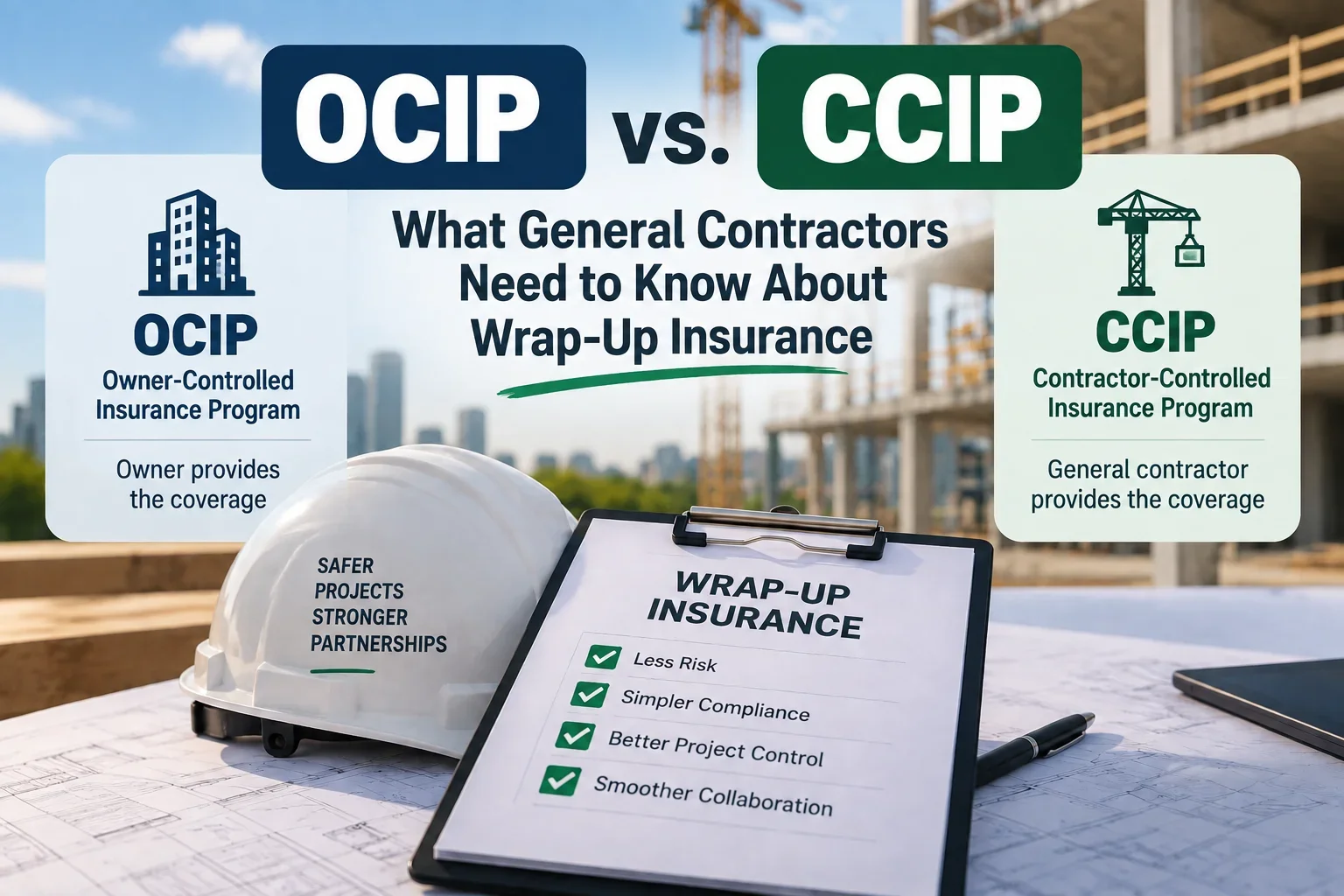
Large construction projects sometimes replace the traditional model of each contractor carrying separate project insurance with a coordinated wrap-up insurance program. The two structures most commonly discussed are an Owner Controlled Insurance Program (OCIP) and a Contractor Controlled Insurance Program (CCIP).
The difference sounds simple: the owner controls an OCIP, while the general contractor controls a CCIP. But the compliance implications are more important than the acronym. Enrollment, payroll reporting, certificates, excluded exposures, and coverage that remains outside the wrap-up all need to be understood and documented.
Federal Highway Administration materials and construction insurance references describe wrap-ups as project-specific insurance arrangements that can consolidate coverage for participating contractors and subcontractors. citehttps://www.fhwa.dot.gov/innovativeprograms/pdfs/ocip.pdf
This guide explains the difference between OCIP and CCIP from a GC and subcontractor-compliance perspective.
What is a wrap-up insurance program?
A wrap-up, also called a controlled insurance program or CIP, is a coordinated insurance arrangement that covers eligible project participants under a master program instead of requiring every participant to provide separate project coverage for the covered exposures.
Depending on the program, coverage can include general liability, workers' compensation, employers' liability, excess liability, and other project-specific coverages. The actual program documents control what is included and excluded.
The important word is eligible. A wrap-up does not automatically mean every company, every employee, every location, or every type of work is covered.
What is an OCIP?
OCIP stands for Owner Controlled Insurance Program.
The project owner sponsors and controls the insurance program. The owner or its program administrator establishes enrollment procedures, coordinates coverage, and manages the program according to the insurance documents.
An OCIP may cover the general contractor and enrolled subcontractors working within the defined project scope and location.
For an enrolled subcontractor, the practical workflow may include:
- Completing enrollment forms
- Providing requested company information
- Reporting payroll or other exposure information
- Following project safety and claims procedures
- Receiving evidence of enrollment
- Maintaining separate insurance for excluded exposures
The program documents determine the actual requirements.
What is a CCIP?
CCIP stands for Contractor Controlled Insurance Program.
The general contractor or construction manager sponsors and administers the wrap-up instead of the owner. The basic concept is similar: eligible contractors and subcontractors participate in a coordinated insurance program for defined project exposures.
The major structural difference is who controls the program.
| Feature | OCIP | CCIP |
|---|---|---|
| Sponsor | Owner | General contractor/CM |
| Program control | Owner | GC/CM |
| Enrollment | Program administrator | GC/CM or administrator |
| Covered parties | Defined by program | Defined by program |
| Project-specific requirements | Yes | Yes |
| Separate coverage still needed | Often | Often |
The actual insurance terms can differ significantly from one project to another.
OCIP vs. CCIP: the key difference
The easiest way to remember it is:
OCIP = owner-controlled.
CCIP = contractor-controlled.
That distinction affects administration, claims management, cost allocation, enrollment, and responsibility for maintaining the program.
It does not mean one structure is automatically better.
What does this mean for subcontractor compliance?
This is where wrap-up projects can create confusion.
A subcontractor may be told that it does not need to provide the same project insurance it normally carries because the wrap-up covers certain exposures. But the subcontractor may still need to maintain its own insurance for exposures outside the program.
Common examples can include:
- Commercial auto
- Off-site operations
- Professional liability
- Tools and equipment
- Pollution exposures not included in the program
- Work outside the defined project site
- Coverage required by the subcontract but not included in the wrap
Never assume that “enrolled in the wrap-up” means “no insurance documentation required.” The program manual and contract should be the source of truth.
Enrollment is a compliance requirement
One of the most important operational controls is confirming that the subcontractor is actually enrolled before it begins covered work.
A practical workflow is:
- Identify whether the subcontractor must participate.
- Submit enrollment information.
- Confirm acceptance by the program administrator.
- Receive the applicable enrollment evidence or certificate.
- Record the effective date.
- Confirm which project and scope the enrollment covers.
- Track any separate insurance requirements.
This creates a much stronger record than simply storing a PDF somewhere in a project folder.
Why standard COI tracking can become confusing on a wrap-up project
On a traditional project, the GC may expect a subcontractor's own carrier to provide a COI showing general liability and workers' compensation.
On a wrap-up project, the evidence may instead come from the controlled insurance program administrator. At the same time, the subcontractor may still need to provide evidence of insurance for exposures that the wrap does not cover.
That means a compliance system should distinguish between:
- Wrap-up enrollment evidence
- Subcontractor's own insurance
- Project-specific requirements
- Excluded exposures
- Expiration dates
- Required endorsements
Combining all of these into one generic “COI received” checkbox can hide important gaps.
A practical wrap-up compliance matrix
| Compliance item | Question |
|---|---|
| Enrollment | Is the subcontractor enrolled in the program? |
| Effective date | Does enrollment begin before covered work? |
| Project | Does the enrollment apply to the correct project? |
| Scope | Is the subcontractor's work within the program scope? |
| Payroll | Are required payroll reports being submitted? |
| Auto | Is separate auto coverage required? |
| Off-site work | Is separate coverage required for off-site operations? |
| Professional liability | Is it required outside the wrap? |
| Equipment | Is equipment separately insured? |
| Other requirements | Does the subcontract require additional evidence? |
This matrix should be customized to the actual program.
What subcontractors should ask before bidding
Subcontractors should understand how the wrap-up affects their bid and insurance program.
Questions worth asking include:
- Which coverages are included?
- Which coverages are excluded?
- Who pays the program premium?
- Is an insurance credit required in the bid?
- What deductibles or retentions apply?
- What payroll reporting is required?
- What happens with off-site operations?
- What happens after project completion?
- What insurance must remain in force?
- What enrollment deadlines apply?
The GC and insurance administrator should provide the controlling documents.
What general contractors should document
For a GC, a strong wrap-up record should connect the subcontractor to the actual insurance program.
Store:
- Executed subcontract
- Wrap-up manual or applicable requirements
- Enrollment submission
- Enrollment confirmation
- Effective dates
- Project assignment
- Payroll-reporting status where applicable
- Separate COIs
- Required endorsements
- Exceptions
- Review history
This helps avoid a common problem: knowing that a subcontractor was “supposed to be covered” without being able to prove exactly what coverage applied and when.
How SubCada fits into wrap-up compliance
SubCada is not an OCIP/CCIP administrator or insurance adviser. The useful role is document organization and compliance visibility.
A GC can use a centralized compliance record to distinguish wrap-up enrollment documents from the subcontractor's own insurance documents, track expiration dates for separate coverage, and keep exceptions visible to the project team.
That becomes especially useful when the same subcontractor works across projects with different insurance structures.
Frequently asked questions
Is an OCIP the same as a CCIP?
No. Both are controlled insurance programs, but an OCIP is generally controlled by the owner while a CCIP is controlled by the contractor or construction manager.
Does a wrap-up eliminate all subcontractor insurance requirements?
No. Coverage depends on the specific program. Auto, professional liability, off-site operations, equipment, and other exposures may remain outside the wrap-up.
Does enrollment happen automatically?
Not necessarily. Eligible subcontractors generally must complete the program's enrollment requirements before participating.
Should a GC still track subcontractor documents on a wrap-up project?
Yes. The exact documents depend on the program and contract, but enrollment evidence and separate coverage requirements should be tracked so the GC can demonstrate compliance.
Is a wrap-up better than traditional subcontractor insurance?
Neither structure is universally better. The appropriate arrangement depends on project size, risk, contractual requirements, program economics, and the parties' ability to administer it.
Final takeaway
OCIP and CCIP programs can simplify insurance administration on qualifying construction projects, but they also create a different compliance workflow. The key is to separate what the wrap-up covers from what the subcontractor must still provide independently.
For general contractors, the best process is simple: document enrollment, understand exclusions, track separate insurance requirements, and maintain a clear record of what applied to each subcontractor and project.
This article is general informational content and is not insurance or legal advice. Controlled insurance programs vary by project and policy. Review the actual program documents and consult qualified insurance and legal professionals for project-specific decisions.