
A general contractor may work with electricians, plumbers, roofers, concrete crews, excavators, painters, HVAC contractors, demolition companies, and dozens of other specialty trades. Treating every subcontractor as if they have the same insurance exposure can create two problems: requiring unnecessary coverage from lower-risk trades while failing to address specialty exposures that actually matter.
A better approach is to start with the contract and scope of work, then build a trade-appropriate insurance requirement profile.
There is no universal insurance package that every subcontractor must carry. Requirements depend on the contract, project, scope, jurisdiction, risk profile, owner requirements, and applicable insurance advice. Current construction insurance guidance also highlights trade-specific exposures such as pollution for certain environmental or demolition work and specialized liability considerations for crane operations. citehttps://tradesafeinsurance.com/general-liability-insurance-for-contractors/subcontractor-insurance-requirements/
Why trade matters when setting insurance requirements
A subcontractor's scope can materially change the types of loss a project may face.
For example, an excavation contractor may create subsurface or utility-damage exposures that are different from those of a flooring contractor. A demolition contractor may encounter pollution or hazardous-material concerns. A crane operator may have specialized rigging exposures. A professional design consultant has a different risk profile again.
The correct question is not:
“What insurance should every subcontractor have?”
It is:
“What insurance evidence does this subcontractor need for this scope, project, contract, and jurisdiction?”
Start with the contract, not an internet checklist
Online checklists can be useful for brainstorming, but they should not become the contractual requirement automatically.
Before creating a requirement profile, identify:
- Scope of work
- Project location
- Contract value
- Owner requirements
- General contractor requirements
- Insurance exhibit
- Required limits
- Required endorsements
- Project duration
- Completed-operations requirements
- Specialty exposures
- Applicable law and licensing requirements
Your broker, risk manager, attorney, or other qualified professional should help determine project-specific insurance requirements when necessary.
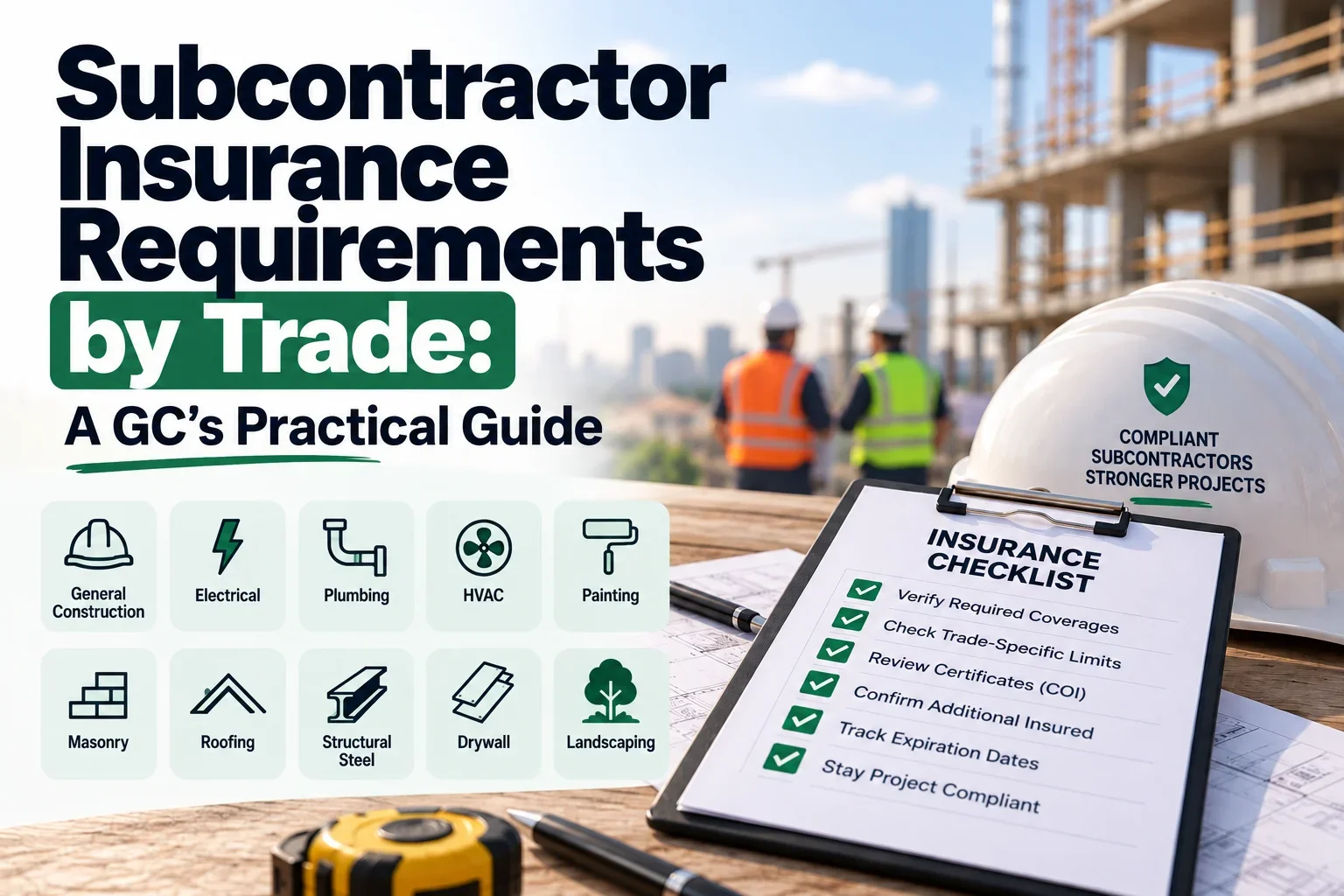
A trade-based insurance framework
The following is a framework for questions to ask, not a universal list of required limits.
| Trade | Potential exposures to investigate | Possible insurance considerations |
|---|---|---|
| Electrical | Bodily injury, property damage, completed operations | CGL, workers' comp, auto; project-specific endorsements |
| Plumbing | Water damage, completed operations | CGL, workers' comp, auto; project-specific requirements |
| HVAC | Equipment, water, refrigerant-related exposure | CGL, workers' comp, auto; specialty coverage where required |
| Roofing | Falls, property damage, completed operations | CGL, workers' comp, auto; higher limits may be contract-specific |
| Excavation | Utility damage, subsurface operations, equipment | CGL, workers' comp, auto; pollution/specialty coverage where applicable |
| Demolition | Property damage, hazardous materials, pollution | CGL, workers' comp, auto; pollution coverage where required |
| Crane/lifting | Rigging, equipment, property damage | CGL, workers' comp, auto; specialized coverage where required |
| Painting/coatings | Chemical exposure, overspray, completed operations | CGL, workers' comp; pollution considerations where applicable |
| Concrete/masonry | Structural work, equipment, property damage | CGL, workers' comp, auto; project-specific limits |
| Professional services | Design errors, professional negligence | Professional liability/E&O where required |
The table is a starting point for risk analysis, not a replacement for the actual insurance requirements.
General liability: verify the actual contract limit
Many construction contracts use general liability limits, but the amount should come from the project requirements rather than an assumed industry number.
Review at least:
- Each-occurrence limit
- General aggregate
- Products/completed operations requirements
- Per-project or per-location aggregate requirements where applicable
- Any required endorsements
- Policy dates
Do not mark a subcontractor compliant simply because its COI contains a familiar limit. Compare the actual limit with the written requirement.
Workers' compensation and employers' liability
Workers' compensation requirements can vary by jurisdiction and worker classification. A GC should verify the applicable requirements rather than relying on a nationwide assumption.
For compliance tracking, record:
- Coverage evidence
- Applicable jurisdiction
- Policy dates
- Employers' liability requirements when applicable
- Any documented exemption or exception
The Department of Labor notes that workers' compensation for private employers is generally administered through state programs, with certain federal programs covering specialized categories. citehttps://www.dol.gov/general/aboutdol/majorlaws
Auto liability depends on the work
A subcontractor that drives company vehicles, transports materials, operates heavy equipment on public roads, or has employees driving as part of the scope can create significant auto exposure.
The contract should establish the required coverage and limit. The reviewer should then compare the COI and supporting evidence with that requirement.
Do not assume that a general liability policy automatically substitutes for commercial auto coverage.
Specialty trades need specialty questions
The biggest weakness of a generic checklist is that it may stop at standard GL, workers' compensation, and auto coverage.
Some trades require additional review.
Demolition and excavation
Ask whether the scope involves:
- Hazardous materials
- Contaminated soil
- Underground utilities
- Blasting
- Structural demolition
- Environmental exposure
The insurance requirements should reflect the actual work and contract.
Roofing
Consider:
- Completed operations
- Fall-related risk
- Hot work
- Roofing-specific exclusions
- Project limits
Crane and lifting operations
Review:
- Who owns the equipment
- Who operates it
- Rigging responsibilities
- Lift plans where applicable
- Equipment and liability coverage
- Contract-specific requirements
Professional services
Architects, engineers, consultants, and certain specialty subcontractors may need professional liability coverage because their primary risk is not the same as physical trade work.
Don't confuse insurance requirements with license requirements
Insurance and licensing are related to contractor qualification, but they are separate compliance questions.
A subcontractor can have a current license and still fail the project's insurance requirement. It can also have compliant insurance while lacking a required license.
Track them as separate fields and separate review decisions.
Don't confuse the COI with the entire insurance requirement
The COI is useful evidence, but it does not necessarily prove every contractual insurance condition.
Where a contract requires additional insured status, waiver of subrogation, primary and noncontributory wording, or another endorsement, the underlying endorsement or policy provision may need to be reviewed.
That is why a strong trade-specific requirement profile should contain both coverage requirements and document requirements.
Build a trade-specific compliance profile
Instead of maintaining one giant checklist, create requirement profiles.
For example:
Electrical subcontractor
- General liability
- Workers' compensation
- Auto if applicable
- Required additional insured endorsement
- Waiver of subrogation if required
- License
- Contract
Demolition subcontractor
- General liability
- Workers' compensation
- Auto
- Pollution coverage where required
- Specialty endorsements
- License
- Contract
- Safety documentation where required
This makes the review more consistent and easier to audit.
Use project-specific overrides
Even two electricians may have different requirements on different projects.
One project may require higher limits because of the owner contract. Another may have an OCIP. A hospital project may impose additional requirements. A residential renovation may create a different exposure profile.
Your compliance workflow should therefore support:
Trade profile + Project requirements + Contract-specific overrides
rather than one universal checklist.
A practical insurance review workflow
- Identify the trade. Understand exactly what the subcontractor will do.
- Read the contract. Extract written insurance requirements.
- Identify specialty exposures. Consider work-specific hazards.
- Create the requirement profile. Separate coverage, limits, endorsements, and documents.
- Collect evidence. Request the current COI and supporting documents.
- Compare. Check each requirement individually.
- Document exceptions. Record exactly what is missing.
- Approve or escalate. Use your organization's rules for compliance decisions.
- Track expiration. Set renewal follow-up before the evidence becomes stale.
- Re-review after changes. Repeat when scope or contract requirements materially change.
Trade-specific insurance checklist
- [ ] Scope of work reviewed
- [ ] Contract requirements extracted
- [ ] Project location considered
- [ ] Required GL limits identified
- [ ] Workers' compensation requirements identified
- [ ] Auto requirement identified
- [ ] Specialty coverage considered
- [ ] Required endorsements identified
- [ ] Current COI received
- [ ] Supporting endorsements received when required
- [ ] License tracked separately
- [ ] Exceptions documented
- [ ] Expiration dates tracked
- [ ] Review history retained
How SubCada can help
The difficult part of trade-specific compliance is not just collecting documents. It is remembering what each subcontractor is required to provide and whether those requirements change by project.
SubCada can help centralize subcontractor documents, requirements, expiration dates, and compliance status so project teams have one place to review what is missing and what needs attention.
The software does not determine what insurance a project legally requires. Those requirements should come from your contracts and qualified insurance or legal professionals.
Frequently asked questions
Does every subcontractor need the same insurance limits?
No. Requirements vary by contract, project, scope, owner requirements, jurisdiction, and risk profile.
Should specialty trades have additional insurance?
Some may. The correct answer depends on the work and contractual requirements. Demolition, excavation, crane operations, pollution-related work, and professional services can require additional analysis.
Is $1 million general liability always enough?
No universal limit applies to every project. The required limit should come from the applicable contract and risk requirements.
Should license and insurance compliance be tracked separately?
Yes. They are separate requirements and should have separate evidence and review status.
Can a COI prove every insurance requirement is satisfied?
Not necessarily. Some contractual requirements depend on endorsements or policy provisions that should be reviewed separately.
Final takeaway
The best subcontractor insurance checklist is not the longest one. It is the one that matches the actual work, actual contract, actual project, and actual risk.
General contractors should build trade-specific requirement profiles, apply project-specific overrides, verify the evidence against the contract, and keep the compliance record current throughout the project.
This article is general informational content and is not legal or insurance advice. Coverage requirements and limits vary by project, contract, jurisdiction, trade, insurer, and risk profile. Consult qualified insurance and legal professionals for project-specific requirements.