
A Certificate of Insurance (COI) for a subcontractor is a document that summarizes the subcontractor's active insurance policies, policy dates, coverage limits, and insurers. General contractors commonly collect COIs before work begins and review them against project and contract requirements.
A COI is useful evidence of coverage, but it is not the insurance policy itself. It also does not automatically prove that every required endorsement or contract condition is in place. For that reason, general contractors should treat COI review as a verification process, not simply a file-collection task.
This guide explains what a subcontractor COI is, how to read an ACORD 25 certificate, what coverage and endorsements to check, and how to keep COI compliance current throughout a project.
What Is a Certificate of Insurance for a Subcontractor?
A Certificate of Insurance is a standardized summary of insurance coverage issued by an insurance producer, broker, or carrier. In construction, a subcontractor may provide a COI to a general contractor as evidence that required insurance policies are in force.
Many U.S. businesses use the ACORD 25 Certificate of Liability Insurance for this purpose. The certificate typically identifies the insured business, insurance companies, policy numbers, effective and expiration dates, types of coverage, limits, and the certificate holder.
The parties usually play different roles:
- Subcontractor / insured: The company whose insurance is summarized on the certificate.
- Insurance producer or broker: The party that prepares or issues the certificate on behalf of the insurer.
- General contractor / certificate holder: The company receiving the certificate for compliance review.
- Insurer: The insurance company providing the underlying policy.
Why General Contractors Collect Subcontractor COIs
General contractors use COIs to confirm that subcontractors have insurance that aligns with project, contract, owner, lender, or carrier requirements.
A consistent COI review process can help a GC identify problems before work starts, such as expired policies, insufficient limits, missing required coverage, incorrect company names, or missing endorsements.
COIs also become important during insurance audits and claims. However, requirements can differ by state, insurer, project, trade, and contract, so a GC should compare each subcontractor's documents with the actual requirements that apply to that job.
For a broader look at how coverage may vary by trade, see Subcontractor Insurance Requirements by Trade.
What Should a GC Check on a Subcontractor COI?
A useful COI review goes beyond checking whether a PDF exists. At minimum, compare the certificate with your subcontract agreement and insurance requirements.
Subcontractor COI checklist
- Correct legal business name — Confirm the insured name matches the subcontractor you hired.
- Insurance companies — Identify the carriers providing each policy.
- Policy numbers — Check that the certificate lists the applicable policies.
- Effective and expiration dates — Make sure coverage is active for the period in which work is being performed.
- Commercial General Liability — Compare occurrence and aggregate limits with your contract requirements.
- Workers' Compensation and Employers' Liability — Confirm the required coverage is shown where applicable.
- Commercial Auto Liability — Verify coverage if vehicles are part of the subcontractor's operations or your contract requires it.
- Umbrella or Excess Liability — Check whether additional limits are required for the project or trade.
- Certificate holder — Confirm the correct entity and address are listed when required.
- Additional insured requirements — Do not rely only on a checkbox; verify required endorsements when necessary.
- Waiver of subrogation — Check whether the contract requires it and whether the appropriate endorsement exists.
- Primary and noncontributory wording — Verify this when required by contract.
- Description of operations — Review project-specific wording, locations, operations, and referenced endorsements.
This checklist is a starting point. Your contract, insurer, broker, or risk adviser may require additional documentation.
How to Read an ACORD 25 Certificate of Insurance
An ACORD 25 certificate contains several sections. Reading them in a consistent order makes it easier to spot gaps.
1. Producer
The producer section identifies the insurance agency or broker that issued the certificate. If something appears inconsistent or needs clarification, this is often the contact point for the insured's insurance program.
2. Insured
The insured section should identify the subcontractor's legal business entity. A mismatch between the subcontract agreement and the COI can create confusion during compliance review.
3. Insurers Affording Coverage
The certificate lists the insurance companies associated with the policies shown below. Each carrier is assigned a letter that corresponds to the policy rows.
4. Types of Insurance
The certificate may show Commercial General Liability, Automobile Liability, Umbrella/Excess Liability, Workers' Compensation and Employers' Liability, and other coverage.
5. Policy Numbers and Dates
Review both the policy number and the effective and expiration dates. A certificate can look complete while still containing a policy that expires before the subcontractor's work is finished.
6. Limits
Compare the limits on the COI with the requirements in your subcontract or insurance exhibit. Do not assume that one standard limit is appropriate for every project or trade.
7. Description of Operations
This area may contain project information, additional insured references, waiver wording, or endorsement details. It should be reviewed carefully, but certificate wording does not replace an endorsement or the policy itself.
8. Certificate Holder
The certificate holder section identifies the party receiving the COI. Make sure the entity is listed correctly when your requirements call for it.
Common Insurance Coverages Shown on a Subcontractor COI
Commercial General Liability COI
Commercial General Liability (CGL) generally addresses third-party bodily injury, property damage, and other covered liability exposures arising from business operations.
GCs often compare the COI's per-occurrence and aggregate limits with the subcontract requirements. Completed operations coverage can also matter for construction work because claims may arise after a subcontractor has finished its scope.
Workers' Compensation COI
Workers' Compensation coverage addresses employee work-related injuries where required by applicable law. Requirements, exemptions, and classifications vary by jurisdiction and business structure, so the certificate should be reviewed in the context of the project and applicable rules.
Employers' Liability limits may also be shown alongside Workers' Compensation.
Commercial Automobile Liability
Auto liability may be required when subcontractors use owned, hired, or non-owned vehicles in connection with the project. Compare the coverage shown with the contract requirements rather than assuming all auto exposures are covered.
Umbrella / Excess Liability
Umbrella or excess coverage may provide additional limits above underlying policies. Larger projects or higher-risk trades may require higher limits than the subcontractor carries under its primary policy alone.
What Is Subcontractor COI Compliance?
Subcontractor COI compliance means more than having a certificate on file. It means the subcontractor's insurance documentation satisfies the requirements that apply to the project and remains current while the subcontractor is performing work.
A subcontractor may have a COI and still be noncompliant. Examples include:
- A policy has expired.
- Limits are below the contractual requirement.
- A required type of insurance is missing.
- The insured business name does not match the subcontractor.
- A required additional insured endorsement has not been provided.
- A waiver of subrogation is required but not documented.
- Primary and noncontributory status is required but not supported by the applicable policy language or endorsement.
That distinction is why COI management should combine document collection, verification, expiration tracking, and follow-up.
Additional Insured, Waiver of Subrogation, and Primary & Noncontributory
These three requirements frequently appear in construction insurance specifications, but they are not interchangeable.
Additional Insured
Additional insured status can provide another party with certain rights under the subcontractor's policy, subject to the policy and endorsement language. A COI checkbox alone should not be treated as a substitute for the required endorsement.
Construction contracts commonly reference forms such as CG 20 10 and CG 20 37. For a deeper explanation, read CG 20 10 vs. CG 20 37: What General Contractors Need to Know.
Waiver of Subrogation
A waiver of subrogation can limit an insurer's ability to pursue recovery against another party after paying a covered claim, depending on the policy and endorsement terms. Learn more in What Is a Waiver of Subrogation in Construction Insurance?.
Primary and Noncontributory
When required and properly endorsed, primary and noncontributory wording addresses how the subcontractor's coverage responds in relation to certain other available insurance. See What Does Primary and Noncontributory Mean in Construction Insurance?.
Common Subcontractor COI Problems
Even when a certificate has been collected, a GC may still need to resolve issues before treating the subcontractor as compliant.
Common problems include:
- Expired or soon-to-expire policies
- Missing coverage types
- Limits below contract requirements
- Incorrect insured or certificate-holder information
- Missing project or operations wording
- Required endorsements not provided
- Old certificates being reused for a new policy period
- Renewals arriving after the previous policy has already expired
The best time to resolve these issues is before mobilization, not after a claim or audit begins.
A structured onboarding process can help. See Subcontractor Onboarding Checklist: What to Collect Before Work Starts.
How Often Should Subcontractor COIs Be Updated?
A COI should be refreshed when the underlying policy renews or when another material change requires new evidence of coverage. Because different policies may renew at different times, a GC should track the actual expiration dates rather than relying on an annual calendar reminder for every subcontractor.
If a subcontractor remains active on a project when a policy is approaching expiration, request updated documentation before the current coverage period ends.
This is one reason spreadsheet-based COI tracking becomes difficult as a contractor's subcontractor list grows.
Manual COI Tracking vs. Automated COI Management
Smaller teams often begin with spreadsheets, email folders, and calendar reminders. That can work at low volume, but it becomes harder to maintain as the number of subcontractors, projects, policy dates, and document requirements increases.
Typical manual-tracking problems include:
- Expiration dates being missed
- Renewal requests being sent late
- Multiple versions of the same document being stored in different places
- Staff spending time repeatedly following up for updated certificates
- Difficulty showing a complete compliance history during an audit or project review
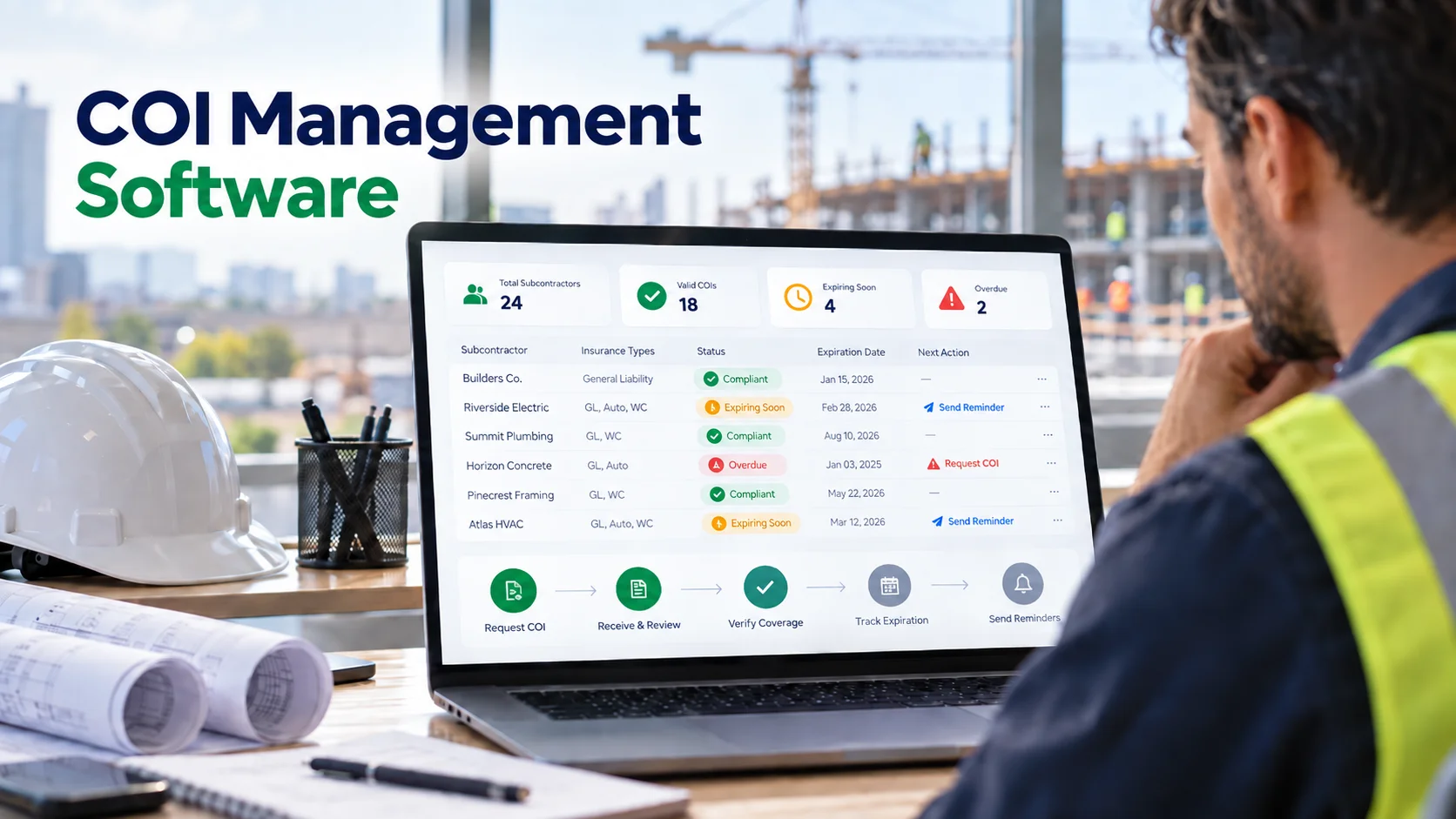
A COI management system can centralize subcontractor records, document requirements, expiration dates, reminders, and renewal uploads.
SubCada is built for general contractors that need to track subcontractor compliance documents. It can help organize document requirements and follow up on expiring or missing documents without relying on a separate spreadsheet for every project.
Frequently Asked Questions About Subcontractor COIs
What is a COI for a subcontractor?
A subcontractor COI is a Certificate of Insurance that summarizes insurance policies carried by the subcontractor. General contractors use it as part of the process of verifying whether the subcontractor meets project insurance requirements.
Does every subcontractor need a Certificate of Insurance?
Not every subcontractor is subject to identical requirements. The need for a COI and the required coverages depend on factors such as the contract, project, trade, state law, owner requirements, and the GC's insurance program.
What should a general contractor look for on a COI?
A GC should verify the insured business name, policy dates, coverage types, limits, insurers, certificate holder, and any contract-required endorsements or conditions. The COI should be compared directly with the subcontract's insurance requirements.
Is an ACORD 25 proof of insurance?
An ACORD 25 is commonly used as evidence that specified insurance coverage was in force when the certificate was issued. It is not the insurance policy and does not replace the terms, exclusions, conditions, or endorsements of the underlying policy.
What is COI compliance?
COI compliance means the subcontractor's insurance documentation meets the requirements that apply to the project and remains current. A certificate on file does not by itself guarantee compliance.
Does a COI prove additional insured status?
A COI may indicate additional insured status, but the certificate itself generally does not amend the insurance policy. When a contract requires additional insured coverage, the applicable endorsement should be verified as appropriate.
How often should a GC review subcontractor COIs?
Review the COI before work begins and again whenever a relevant policy renews, expires, or materially changes. Active subcontractors should not be treated as permanently compliant based on an old certificate.
Build a Repeatable COI Compliance Process
A reliable subcontractor insurance process has four parts: define the requirements, collect the correct documents, verify them against the contract, and track renewals before coverage expires.
The COI is an important part of that process, but it works best when it is connected to the rest of your subcontractor compliance system rather than stored as an isolated PDF.
If your team is still tracking certificates manually, see how SubCada works to centralize subcontractor documents and expiration tracking.