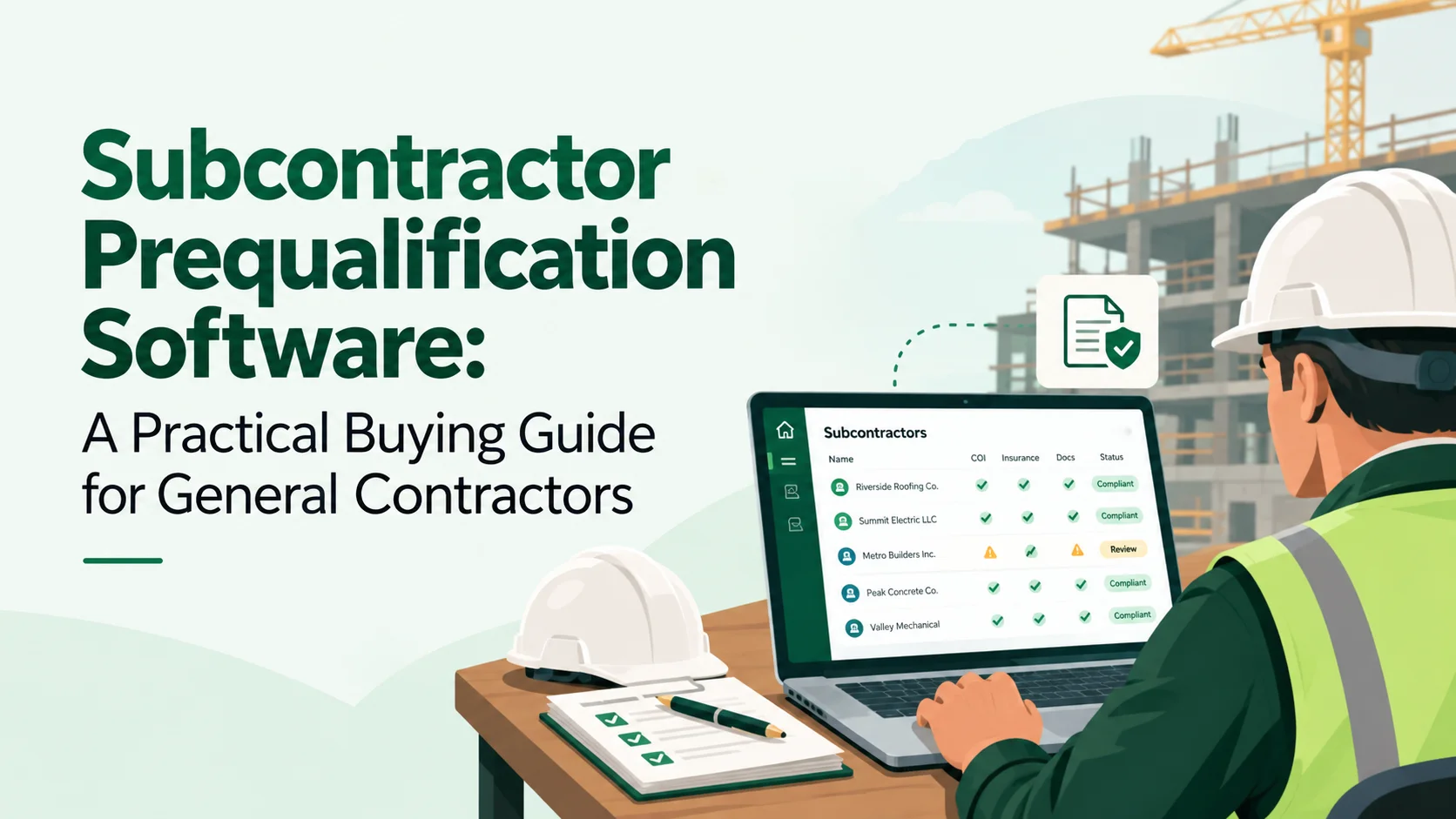


Subcontractor onboarding is more than collecting a signed agreement and a certificate of insurance. Before a trade starts work, a general contractor needs a repeatable process for confirming that the subcontractor is properly contracted, appropriately insured, qualified for the scope, and ready to meet the project's requirements.
A good onboarding process also creates the foundation for ongoing compliance. Documents expire, project requirements change, and new information can be needed during the job. The goal is to create a record that tells your team what was required, what was received, what was reviewed, and what still needs attention.
This checklist is designed for U.S. general contractors and construction teams. Exact requirements vary by project, contract, trade, and jurisdiction, so treat it as a framework rather than a universal legal checklist.
What should be collected during subcontractor onboarding?
The exact packet depends on the project, but a practical onboarding process commonly covers these areas:
| Area | Examples | Why it matters |
|---|---|---|
| Contract | Executed subcontract, scope, exhibits | Establishes the relationship and requirements |
| Insurance | COI, required endorsements | Provides evidence against contract requirements |
| Licensing | State/local trade licenses | Confirms required credentials where applicable |
| Tax/vendor setup | W-9 and vendor information | Supports payment and tax administration |
| Safety | Required safety records, orientations, training | Supports project safety requirements |
| Company information | Legal entity, contacts, emergency contacts | Keeps the vendor record accurate |
| Project documents | Site rules, schedule information, submittal requirements | Helps the subcontractor operate within project procedures |
| Payment documents | Schedule of values, billing instructions, lien-waiver process | Establishes the payment workflow |
Not every project requires every item. The important part is deciding what applies before the subcontractor reaches the jobsite.
1. Start with the executed subcontract
The subcontract should be the starting point for onboarding because it defines many of the requirements you need to track.
Before approving the subcontractor, verify that the agreement is fully executed and that the relevant exhibits are attached. Pay particular attention to:
- Scope of work
- Contract amount and payment terms
- Insurance requirements
- Indemnification provisions
- Required licenses or qualifications
- Safety requirements
- Project-specific exhibits
- Document submission requirements
- Change-order procedures
- Lower-tier subcontractor requirements
Do not build your onboarding checklist independently from the contract. The contract is one of the sources that determines what the subcontractor actually needs to provide.
2. Collect and review the certificate of insurance
Insurance is one of the most important onboarding controls for a general contractor.
Request the current certificate of insurance and compare it with the insurance requirements that apply to the subcontract. Review the policy dates, required coverage types, limits, named insured, and any project-specific information required by the contract.
A COI is useful evidence, but it is not the same thing as the underlying insurance policy. When the contract requires additional insured status, waiver of subrogation, primary and noncontributory wording, or other endorsements, obtain the supporting documentation required by the contract.
Insurance onboarding checklist
- [ ] Current COI received
- [ ] Named insured matches the contracting entity
- [ ] Policy dates are current
- [ ] Required general liability coverage is shown
- [ ] Workers' compensation requirements are addressed where applicable
- [ ] Auto liability is addressed where applicable
- [ ] Umbrella/excess coverage is addressed where required
- [ ] Required limits match the contract
- [ ] Additional insured documentation received when required
- [ ] Waiver of subrogation documentation received when required
- [ ] Primary/noncontributory requirement reviewed when applicable
- [ ] Expiration dates entered into the compliance record
3. Verify required licenses
A subcontractor may need a state, county, city, or trade-specific license depending on the work and location.
Do not simply accept a license number typed into an onboarding form. Where an official licensing database is available, verify the relevant credential against the issuing authority and record the expiration date.
The exact rules vary significantly by jurisdiction and trade. Electrical, plumbing, mechanical, roofing, general construction, and specialty work can have different licensing requirements.
Your internal checklist should therefore identify the required credential for the specific scope rather than assume every subcontractor needs the same license.
4. Confirm the legal entity
The entity signing the subcontract should be connected to the entity represented by the compliance documents.
Compare the legal name across the:
- Executed subcontract
- COI
- W-9
- License records
- Vendor record
- Required endorsements
Differences such as an LLC suffix, DBA, parent company, or subsidiary do not automatically mean something is wrong. They do mean the relationship should be understood and documented before the onboarding record is marked complete.
This check is especially useful because a beautifully organized compliance file can still be associated with the wrong legal entity.
5. Collect the W-9 and vendor information
For U.S. tax administration, businesses commonly collect Form W-9 from independent contractors to obtain the payee's correct name and taxpayer identification number. The IRS provides specific guidance on Form W-9 and independent-contractor reporting.
Keep tax documents in the appropriate restricted area of your systems because they can contain sensitive information. Your construction compliance workflow should not expose tax identifiers more broadly than necessary.
Separate the question of tax documentation from insurance compliance. A W-9 does not prove insurance coverage, and a COI does not replace tax documentation.
6. Collect safety and project-specific requirements
Insurance and licensing are only part of onboarding.
Depending on the project and scope, the subcontractor may need to complete items such as:
- Site orientation
- Safety acknowledgements
- Required training records
- Emergency-contact information
- Project-specific safety documentation
- Equipment or operator credentials
- Required plans or procedures
- Site-access requirements
The correct list should come from the project's safety program, contract documents, owner requirements, and applicable rules.
A useful approach is to separate company-level requirements from project-level requirements. A contractor's general business license may apply across multiple projects, while a site orientation applies only to a specific project.
7. Set up payment and billing requirements
Onboarding should also make the payment process clear.
Depending on the project, you may need to collect or configure:
- Schedule of values
- Billing contact
- Pay-application instructions
- Invoice submission process
- Retainage rules
- Lien-waiver requirements
- Lower-tier documentation requirements
- ACH or payment information
Payment documentation should be handled according to your company's financial controls. Banking information and tax information should not be stored or shared more broadly than necessary.
8. Identify lower-tier subcontractors
A first-tier subcontractor may hire additional subcontractors or suppliers. Your contract may require those parties to be disclosed and may impose flow-down compliance requirements.
Ask whether the subcontractor expects to use lower-tier firms and determine what your contract requires you to collect from them.
This is an important compliance question because the subcontractor you approved is not necessarily the only outside company performing work under that scope.
9. Create a clear approval status
Avoid marking a subcontractor simply as “onboarded” when several items remain unresolved.
A structured status model can make the process clearer:
| Status | Meaning |
|---|---|
| Pending | Required onboarding information is still being collected |
| Under Review | Documents have been received and are being checked |
| Approved | Required onboarding controls have been satisfied |
| Conditional | Your internal process allows work/payment subject to documented exceptions |
| Rejected | The subcontractor does not satisfy an essential requirement |
The exact status rules are an internal policy decision. The important part is that the status has a defined meaning and is supported by a record of what was reviewed.
10. Track expiration dates from day one
Onboarding should create the starting point for ongoing compliance monitoring.
If the subcontractor's insurance, license, certification, or other required document expires later, that future date needs to be visible to the person responsible for compliance.
A strong workflow looks like this:
Collect → Review → Approve → Record expiration → Remind → Renew → Re-review
Do not treat onboarding as the moment when compliance ends. It is the beginning of the compliance lifecycle.
A complete subcontractor onboarding checklist
Use this as a starting framework and customize it to your project and contracts.
Contract and company
- [ ] Executed subcontract received
- [ ] All required exhibits attached
- [ ] Legal business name verified
- [ ] Primary contact recorded
- [ ] Emergency contact recorded
- [ ] Lower-tier subcontractor requirements identified
Insurance
- [ ] Current COI received
- [ ] Required coverages reviewed
- [ ] Limits compared with contract
- [ ] Policy dates reviewed
- [ ] Additional insured requirement reviewed
- [ ] Required endorsements collected
- [ ] Expiration dates recorded
Licensing and qualifications
- [ ] Required trade license identified
- [ ] License verified
- [ ] License expiration recorded
- [ ] Project-specific credentials checked
- [ ] Required training/qualification records collected
Tax and vendor setup
- [ ] W-9 collected where applicable
- [ ] Vendor record created
- [ ] Payment contact recorded
- [ ] Billing procedure provided
- [ ] Payment documentation requirements explained
Project readiness
- [ ] Site rules provided
- [ ] Safety orientation completed where required
- [ ] Emergency procedures provided
- [ ] Schedule information provided
- [ ] Submittal/RFI process explained
- [ ] Change-order process explained
- [ ] Site-access requirements completed
Ongoing compliance
- [ ] Document expiration dates recorded
- [ ] Renewal workflow assigned
- [ ] Compliance owner identified
- [ ] Exceptions documented
- [ ] Approval status recorded
What should prevent a subcontractor from starting work?
This depends on your contract and internal policy, but a useful concept is to define a small set of mobilization gates before work begins.
For example, a company might require these items before site access:
- Executed subcontract
- Required insurance evidence reviewed
- Required licenses verified
- Required safety/site onboarding completed
- Any project-specific prerequisites satisfied
The point is not to create a universal “no work” rule. It is to decide in advance which requirements are essential and who has authority to approve exceptions.
How to avoid turning onboarding into an email chase
The most common operational problem is not knowing what documents exist. It is knowing what is missing and who needs to provide it.
A simple spreadsheet can work for a small number of subcontractors, but the workflow becomes harder when you have multiple projects, many trades, different requirements, and documents with different expiration dates.
A centralized compliance workflow can connect the subcontractor to:
- Required documents
- Project requirements
- Review status
- Missing items
- Expiration dates
- Reminder history
- Approval decisions
That gives the project team one place to see what is ready and what still needs action.
Frequently asked questions
When should subcontractor onboarding begin?
It is usually best to begin before the subcontractor needs to mobilize. The exact timing depends on the company's procurement and project process, but early collection gives the team time to resolve missing documents before the start date.
Is a COI enough to onboard a subcontractor?
Usually not. A COI addresses insurance evidence, while onboarding can also involve contracts, licenses, tax information, safety requirements, vendor setup, and project-specific documents.
Should every subcontractor have the same onboarding requirements?
No. Requirements should be based on the subcontract, project, scope of work, jurisdiction, and internal policy. A plumbing subcontractor and an office-services vendor may not need the same documents.
Should expiration dates be tracked after onboarding?
Yes. Insurance and other credentials can expire after the subcontractor is approved. Recording the dates during onboarding creates the foundation for ongoing monitoring.
Who should own subcontractor onboarding?
The owner should be clearly assigned by your organization. Depending on the company, procurement, project management, risk/compliance, or operations may own different parts of the process.
What happens when an onboarding document is missing?
Record the missing item, assign responsibility, set a due date, and apply your company's approval rules. Avoid treating an incomplete file as complete simply because the subcontractor is already scheduled to start.
Final takeaway
A strong subcontractor onboarding process turns a pile of documents into a controlled workflow. Start with the contract, identify the requirements that actually apply, collect the appropriate evidence, verify it, record the decision, and carry expiration dates forward into ongoing compliance monitoring.
For general contractors managing multiple subcontractors, SubCada can centralize compliance documents, requirements, expiration dates, and status so your team can see what is complete and what still needs attention.
This article is general informational content and is not legal, tax, insurance, or regulatory advice. Requirements vary by project, contract, trade, and jurisdiction.