
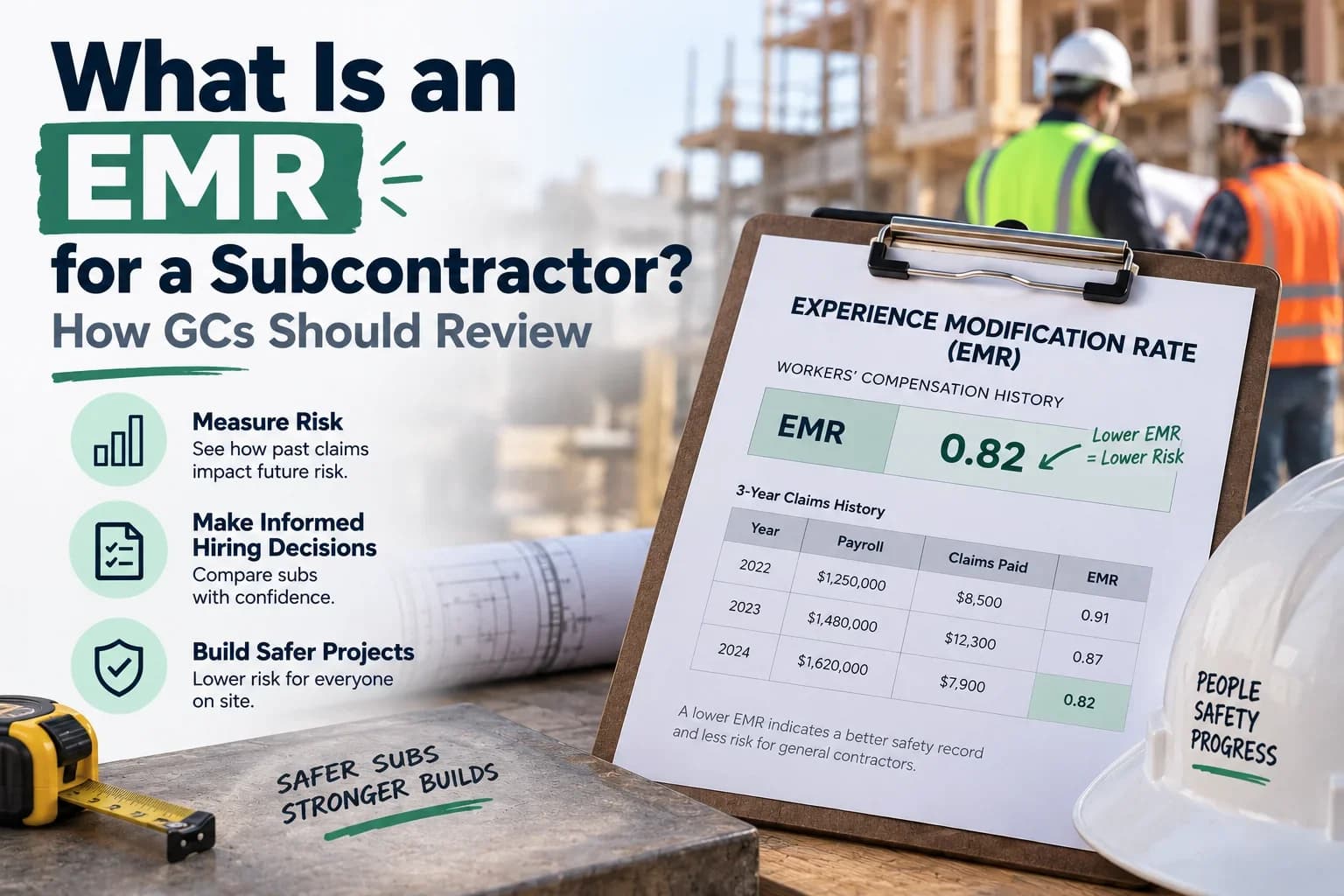
General contractors often ask subcontractors for an Experience Modification Rate (EMR) during qualification. You may see it listed alongside insurance, safety records, licenses, financial information, and project references.
But an EMR is easy to oversimplify. It is not a complete safety score, it is not printed on a standard ACORD 25 certificate, and a single number without its effective period or supporting documentation can be difficult to interpret.
This guide explains what an EMR is, why GCs request it, what to collect, how to review it responsibly, and how to keep the information organized as part of a subcontractor compliance process.
What is an EMR?
An Experience Modification Rate is a workers' compensation experience-rating measure that compares an employer's actual workers' compensation loss experience with expected losses for comparable businesses under the applicable rating system.
The exact calculation and terminology can vary by jurisdiction and rating bureau. In many construction qualification processes, GCs use the EMR as one indicator when evaluating a subcontractor's workers' compensation and safety history.
An EMR around 1.00 is commonly used as a reference point, but it should not be treated as a universal pass/fail standard for every project.
Why do general contractors ask subcontractors for EMR information? For the broader qualification process, see Subcontractor Prequalification: What to Check Before You Hire a Subcontractor.
A subcontractor's workers' compensation history can be relevant to project risk. GCs may use EMR information alongside OSHA records, safety programs, claims history, and other qualification information.
The purpose is generally to understand whether a subcontractor has a history that warrants additional review and whether it meets the project's qualification requirements.
Many actual GC prequalification forms request EMR documentation. For example, DPR's current subcontractor prequalification process requests an EMR worksheet or equivalent documentation from the workers' compensation carrier for the last three years. urlDPR subcontractor prequalification requirementshttps://cmicr12web.dpr.com/cmicprod/PmSsPrequal/SaveSSPrequalP6.do?navPage=6&saveDraft=Y
Is an EMR a safety score?
Not exactly.
An EMR is based on workers' compensation experience-rating methodology. It can provide useful information about loss experience, but it does not measure every part of a company's safety program.
For example, a GC may also want to know about:
- OSHA recordkeeping and citations
- Written safety programs
- Training practices
- Recent incidents
- Corrective actions
- Competent-person requirements
- Job hazard analysis processes
- Safety leadership and supervision
A subcontractor can have a favorable EMR while still having weaknesses that deserve review. Conversely, a higher EMR may have context that a GC should understand before making a decision.
What does a lower or higher EMR generally indicate?
In general terms, an experience modification factor below 1.00 indicates better-than-expected loss experience under the applicable rating methodology, while a factor above 1.00 indicates worse-than-expected experience.
However, GCs should avoid turning that explanation into a universal hiring rule. Rating systems, state rules, employer size, experience periods, and project requirements can affect how the number should be interpreted.
The better question is not simply:
“Is the EMR below 1.00?”
It is:
“What does this EMR represent, what period does it cover, and does it meet this project's documented qualification requirement?”
What documentation should a GC request?
If the project requires EMR verification, ask for documentation rather than relying solely on a number typed into a questionnaire.
Depending on the GC's process, this could include an EMR worksheet, experience-rating letter, or equivalent documentation from the applicable workers' compensation carrier or rating organization.
Check that the document identifies:
- Subcontractor legal name
- Applicable rating period
- EMR or experience modification information
- Effective date
- Issuing carrier, rating bureau, or other source as applicable
- Any other information required by the GC's qualification procedure
Keep the source document with the review record.
How should a GC review an EMR?
Step 1: Confirm the legal entity
The EMR documentation should correspond to the company being evaluated. Be careful with DBAs, affiliates, parent companies, and reorganized entities.
Step 2: Check the period
An EMR is tied to a rating period. Record the effective date and understand what years of experience are represented.
Step 3: Compare it with the project's requirement
If the project documents state an EMR threshold, compare the verified figure with that requirement. Do not substitute a different threshold because it is commonly used elsewhere.
Step 4: Review the trend
If multiple years are available, a trend can provide more context than one current number. A declining number may indicate improvement, while a rising number may warrant questions.
Step 5: Review related safety information
Pair EMR information with the other safety documentation required by the GC's process. An EMR should not be the only safety-related data point.
Step 6: Document the decision
Record whether the requirement was met, whether additional information was requested, and who reviewed it.
EMR vs. OSHA records\n\nFor a detailed explanation of OSHA 300A, see What Is OSHA Form 300A? A General Contractor's Guide to Subcontractor Safety Records.\n\nFor a detailed explanation of OSHA 300A, see What Is OSHA Form 300A? A General Contractor's Guide to Subcontractor Safety Records.
These documents answer different questions.
| Document | What it primarily tells the GC |
|---|---|
| EMR documentation | Workers' compensation experience-rating information |
| OSHA 300A | Annual summary of recordable work-related injuries and illnesses for covered establishments |
| OSHA citations | Regulatory enforcement history and cited conditions |
| Safety program | How the company says it manages workplace hazards |
| Loss runs | Reported claims history under specified insurance policies |
A strong subcontractor qualification process can use several of these sources together rather than treating one number as a complete picture.
Why an EMR may not tell the whole story
The rating period creates a lag
Experience-rating calculations are based on defined historical periods. That means the current number may not fully reflect changes made recently by the subcontractor.
Small employers may have different rating circumstances
Not every employer is necessarily experience-rated in the same way. Qualification procedures should define how companies without an applicable EMR are handled.
Jurisdiction matters
Workers' compensation rating systems are not identical everywhere. State-specific rules and rating organizations can affect how experience modification information is produced and interpreted.
Company changes matter
Mergers, acquisitions, ownership changes, new legal entities, and other corporate changes can make historical comparisons more complicated.
What if a subcontractor has no EMR?
Do not automatically mark the company noncompliant.
Instead, use the GC's documented exception process. The company may be too new, too small, or otherwise outside the applicable experience-rating system.
A useful record might say:
Status: Exception review — no applicable EMR available. Subcontractor provided carrier documentation explaining the rating status. Safety records and other qualification requirements reviewed separately.
That creates a much stronger audit trail than simply entering “N/A.”
Should GCs use a hard EMR cutoff?
Some construction organizations establish EMR thresholds in their qualification procedures. Whether a particular threshold is appropriate depends on the GC, owner, project, trade, jurisdiction, and risk-management requirements.
If your organization uses a threshold, document:
- The required threshold.
- Who approved it.
- Which projects or subcontractor types it applies to.
- How exceptions are handled.
- What supporting evidence must be collected.
- How often the requirement is rechecked.
The important thing is consistency. A rule that exists only in one estimator's spreadsheet is difficult to administer and audit.
How often should EMR information be updated?
The answer should follow the GC's qualification policy and the rating cycle applicable to the subcontractor.
Many construction prequalification programs collect current and historical EMR documentation as part of an annual qualification process. Some project owners or contracts may impose different requirements.
Rather than assuming that every subcontractor needs the same refresh schedule, define the document's review trigger in your compliance process.
Common EMR tracking mistakes
Mistake 1: Tracking only the number
A number without the source document, period, and effective date is difficult to verify later.
Mistake 2: Treating 1.00 as a universal legal requirement
An EMR threshold is generally a qualification or contract requirement, not a universal legal standard.
Mistake 3: Using an old EMR without checking the period
The number may no longer satisfy the project's current qualification requirements.
Mistake 4: Ignoring companies without an EMR
Your process should have a documented way to evaluate companies that are not experience-rated.
Mistake 5: Reviewing EMR without the broader safety picture
Workers' compensation experience is only one component of subcontractor risk review.
EMR review checklist for GCs
- [ ] Legal entity matches subcontractor record
- [ ] Current EMR documentation received
- [ ] Effective/rating period recorded
- [ ] Source identified
- [ ] Project-specific threshold checked
- [ ] Historical trend reviewed when available
- [ ] Related safety records reviewed
- [ ] Exceptions documented
- [ ] Reviewer and review date recorded
- [ ] Next review trigger recorded
How to organize EMR records across subcontractors
EMR documents are easy to lose because they are often collected during prequalification and then forgotten in an email or portal.
A centralized subcontractor record can connect the EMR document to the legal entity, qualification status, projects, and other compliance records. This becomes especially useful when the same subcontractor works on multiple projects or when a new project manager needs to understand why a subcontractor was approved.
SubCada is designed around this broader workflow: keeping subcontractor compliance information organized instead of scattering documents across email, spreadsheets, and project folders.
Frequently asked questions
What is a good EMR for a subcontractor?
A lower experience modification factor generally indicates better-than-expected workers' compensation loss experience under the applicable rating system. What qualifies as acceptable depends on the GC, project, contract, jurisdiction, and documented qualification requirements.
Is an EMR the same as a COI?
No. An EMR is workers' compensation experience-rating information. A COI summarizes insurance coverage information.
Is an EMR required by law?
Not universally. A GC, owner, contract, project, or qualification program may require EMR documentation, but requirements vary.
What if a subcontractor does not have an EMR?
Use the GC's documented exception or alternative-review process. Do not assume that no EMR means poor safety performance.
Should a GC verify an EMR with the insurance carrier?
Where the qualification process requires verification, obtaining documentation from the carrier or applicable rating source is stronger than relying only on a self-reported number.
Final takeaway
An EMR can be a useful part of subcontractor qualification, but it should be treated as one piece of a broader risk-review process. Verify the legal entity, rating period, source documentation, project requirement, and supporting safety information. Then record the result so another member of the team can understand the decision later.
The goal is not simply to collect an EMR number. The goal is to maintain a repeatable, documented subcontractor qualification process.
This article is general informational content and is not legal, insurance, workers' compensation, or safety advice. Requirements and rating methods vary by jurisdiction and project.