
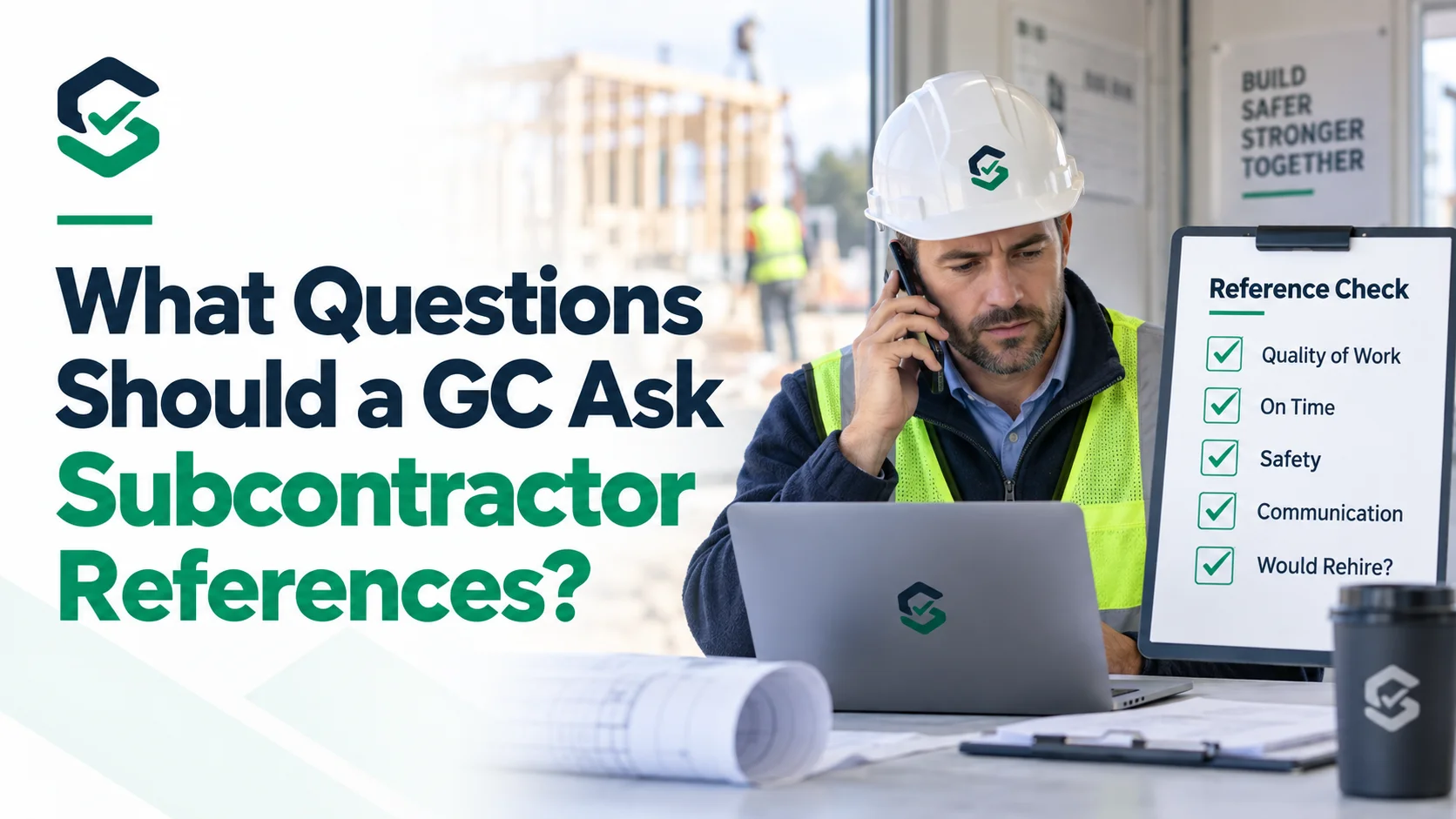
What Questions Should a GC Ask Subcontractor References?
A subcontractor can submit a strong bid, current insurance, a clean-looking qualification form, and impressive project photos. None of those things tells a general contractor exactly what it was like to work with that company on a real project.
That is why subcontractor reference checks can be valuable during prequalification.
A good reference call is not a courtesy call asking, “Would you hire them again?” It is a structured conversation designed to uncover how the subcontractor actually performed: whether it met the schedule, managed quality, communicated problems, handled change orders, worked safely, submitted accurate paperwork, and finished with a professional closeout.
This guide gives GCs a practical reference-check process and a list of questions that can be used before awarding a subcontract.
Why should GCs check subcontractor references?
References provide first-hand information that documents often cannot.
A prequalification package can tell you what a subcontractor reports about itself. A reference can tell you what another owner, GC, construction manager, supplier, or project participant actually experienced.
Reference checks can help answer questions such as:
- Did the subcontractor finish on schedule?
- Was the work performed to the expected quality standard?
- How did the company communicate when problems appeared?
- Were change orders handled professionally?
- Did the subcontractor maintain adequate manpower?
- Were payment or supplier issues reported?
- Did the company complete closeout properly?
- Would the reference hire the subcontractor again?
The goal is not to collect positive comments. The goal is to reduce uncertainty before the GC commits to the subcontract.
What makes a useful subcontractor reference?
The best reference is usually someone who worked closely enough with the subcontractor to evaluate its actual performance.
Depending on the project, useful references can include:
- Previous general contractors
- Construction managers
- Project owners
- Architects or engineers
- Facility managers
- Major suppliers
- Other project partners
A reference should ideally relate to work similar to the proposed project in size, complexity, trade, schedule, or delivery method.
A reference from a small residential project may provide useful information, but it may not answer whether the subcontractor can manage a large occupied commercial project.
What should a GC ask before making the call?
Before contacting the reference, identify what you are actually trying to verify.
Review the subcontractor’s submitted project history and note:
- Project name
- Project type
- Contract value
- Scope performed
- Completion date
- Reference name
- Reference organization
- Reference role
- Contact information
Then choose questions that match the proposed award.
For example, if you are considering a $2 million mechanical package, a reference from a similarly sized mechanical project is more informative than a reference for a small service contract.
15 questions to ask subcontractor references
1. What was the subcontractor’s scope of work?
Start by confirming the basic facts.
Ask the reference to describe what the subcontractor actually performed and how large the assignment was. This helps you determine whether the reference is evaluating the same capabilities you need on your project.
2. Did the subcontractor complete the work on schedule?
Do not stop at yes or no.
Ask whether the company met its contractual milestones and, if it did not, what caused the delay.
A delay caused by an owner-directed change is very different from a delay caused by chronic manpower shortages.
3. Did the subcontractor provide adequate manpower?
This is especially important for schedule-critical trades.
Ask whether the company staffed the project as promised and whether staffing remained adequate during difficult periods.
4. How was the quality of the work?
Ask whether the reference experienced recurring punch-list issues, rework, failed inspections, defective materials, or other quality concerns.
Also ask whether problems were corrected promptly after being identified.
5. How did they handle problems?
Every project has problems. The more useful question is how the subcontractor responded.
Ask for an example of a significant issue and what the subcontractor did after it was identified.
6. How was communication?
Ask whether project managers and field supervisors were responsive and whether the subcontractor communicated schedule, cost, safety, and scope issues early enough for the GC to act.
7. How did they handle change orders?
Change orders can create friction even when the underlying work is good.
Ask whether pricing was understandable, whether supporting documentation was provided, and whether the subcontractor raised legitimate scope changes promptly rather than surprising the GC later.
8. Did the subcontractor cooperate with other trades?
A technically strong subcontractor can still create project problems if coordination is poor.
Ask how the company interacted with other trades and whether there were recurring coordination conflicts.
9. How did they perform on safety requirements?
Where appropriate, ask whether the subcontractor followed the project safety program, attended required meetings, corrected observed issues, and maintained adequate supervision.
Do not treat one reference’s opinion as a substitute for formal safety records. Use it as additional context.
10. Were there payment or supplier concerns?
This question can be sensitive, so ask professionally.
For a supplier reference, ask whether the subcontractor generally paid on time and communicated when problems arose. For a GC reference, ask whether there were recurring disputes involving payment applications, lien waivers, or documentation.
11. Did the subcontractor manage paperwork well?
Ask whether pay applications, closeout documents, submittals, change-order paperwork, and required compliance documents were submitted accurately and on time.
This is particularly relevant when your project requires extensive documentation.
12. How did the subcontractor handle closeout?
A company can perform the physical work well and still create problems at the end of a project.
Ask whether punch-list items, warranties, as-builts, training, final documentation, and other closeout requirements were completed properly.
13. Were there any major disputes?
Ask whether the project involved significant disputes, claims, termination threats, or other escalations.
If the reference says yes, ask for context rather than assuming the subcontractor was at fault.
14. What would you do differently if you hired them again?
This is often more revealing than asking whether they would rehire the subcontractor.
The question gives the reference room to describe manageable weaknesses without forcing a simple positive or negative answer.
15. Would you hire this subcontractor again for a similar project?
Ask this near the end, after the more specific questions.
Then ask why.
The explanation is usually more useful than the yes-or-no answer.