

If your company hires subcontractors, Form W-9 is one of the basic documents that belongs in the vendor file. It is not an insurance certificate and it does not prove that a subcontractor is licensed or compliant with project requirements. Instead, it gives the payer information needed to identify the payee for federal tax reporting.
The IRS says that once a business has determined that a person is an independent contractor, the first step is to have the contractor complete Form W-9, Request for Taxpayer Identification Number and Certification. The form is used to request the payee's correct name and taxpayer identification number, or TIN. The IRS also says the W-9 should be kept in the payer's files for four years. citehttps://www.irs.gov/businesses/small-businesses-self-employed/forms-and-associated-taxes-for-independent-contractors
For a general contractor, the practical challenge is less about understanding one tax form and more about making sure every subcontractor's vendor record is complete, accurate, and easy to retrieve when accounting needs it.
What is Form W-9?
Form W-9 is the IRS form used to request a U.S. payee's taxpayer identification number and certain certifications. A subcontractor generally provides it to the business paying for services rather than sending it directly to the IRS.
The information can include the subcontractor's legal name, business name when applicable, federal tax classification, address, and TIN. The form also contains a certification section that the payee signs.
The W-9 is therefore best treated as a vendor identity and tax-reporting document.
It is not proof of:
- General liability insurance
- Workers' compensation insurance
- A contractor license
- Safety certification
- Additional insured status
- A subcontract agreement
- The legal classification of the worker by itself
The IRS notes that worker classification depends on the facts and circumstances of the relationship, not simply the label used by the parties. citehttps://www.irs.gov/businesses/small-businesses-self-employed/independent-contractor-defined
Why do general contractors collect W-9s from subcontractors?
The primary reason is tax reporting and accurate payee identification.
The IRS explains that businesses that pay independent contractors may need to report nonemployee compensation on Form 1099-NEC when the applicable reporting conditions and threshold are met. citehttps://www.irs.gov/businesses/small-businesses-self-employed/reporting-payments-to-independent-contractors
A completed W-9 gives the payer the name and TIN information needed to support that reporting process.
For a construction company, collecting the W-9 during subcontractor onboarding also prevents a common administrative problem: discovering months later that accounting has a missing or incomplete tax record for a subcontractor who has already been paid.
When should a GC collect a subcontractor W-9?
A practical workflow is to request the W-9 during vendor or subcontractor onboarding, before the first payment whenever your process permits.
A simple sequence is:
- Identify the legal entity you intend to contract with.
- Determine the applicable vendor and tax documentation requirements.
- Request the completed W-9.
- Review the name and TIN information for obvious completeness or mismatch issues.
- Store the W-9 with the subcontractor's vendor record.
- Give accounting access to the approved record.
- Follow up when a required form is missing or needs correction.
The exact timing and process should be aligned with your accounting, tax, legal, and procurement policies.
What information should you review on a subcontractor W-9?
A W-9 review should focus on whether the document is complete and whether it identifies the payee consistently with your vendor records.
1. Legal name
Compare the name on the W-9 with the entity named in your subcontract, purchase order, and vendor record.
A mismatch does not automatically mean the subcontractor is invalid. It means someone should resolve the discrepancy before the vendor record is finalized.
2. Business name
If a subcontractor operates under a DBA or different business name, make sure your records make the relationship clear.
3. Federal tax classification
The W-9 includes a federal tax classification section. Do not assume that a business name or LLC designation alone tells you how the entity should be treated for federal tax reporting.
4. Address
The address should be complete and consistent with the information your company uses for vendor records and tax reporting.
5. Taxpayer identification number
The TIN is one of the most important pieces of information on the form because it supports information reporting. Treat it as sensitive financial information and limit access appropriately.
6. Certification and signature
The form includes certifications that the payee signs. Do not alter the subcontractor's certification or make tax-status decisions on the subcontractor's behalf.
W-9 vs. 1099-NEC: what is the difference?
These forms serve different purposes.
| Document | Who provides it? | Main purpose |
|---|---|---|
| W-9 | Subcontractor/payee | Gives the payer the payee's name, TIN, classification information and certifications |
| 1099-NEC | Payer/business | Reports qualifying nonemployee compensation to the IRS and payee |
The W-9 is an input to the payer's vendor and reporting process. The 1099-NEC is an information return used to report qualifying payments.
The IRS says businesses may need to file Form 1099-NEC when payments to qualifying nonemployees meet the applicable reporting conditions and threshold. citehttps://www.irs.gov/businesses/small-businesses-self-employed/reporting-payments-to-independent-contractors
What happens if a subcontractor does not provide a W-9?
Do not treat a missing W-9 as proof that the subcontractor is uninsured, unlicensed, or otherwise noncompliant. It is a missing tax/vendor document.
However, a missing or incorrect TIN can create tax-reporting and backup-withholding issues. The IRS explains that backup withholding can apply when a payee does not provide a TIN as required or when the IRS notifies the payer that the TIN is incorrect. The backup withholding rate is currently 24% for reportable payments. citehttps://www.irs.gov/businesses/small-businesses-self-employed/backup-withholding
Because withholding rules can be fact-specific, your accounting or tax professional should determine what action is required in a particular case.
Should you verify the TIN on every W-9?
A GC should have a defined process for handling taxpayer information and name/TIN mismatches. The correct verification and reporting process depends on your business circumstances and IRS rules.
The key operational principle is to avoid accepting a W-9 into a vendor file without checking whether the information is complete and consistent with the contracting entity.
Do not try to infer a tax classification or correct a TIN yourself simply because a document looks unusual. Escalate questions to the person responsible for tax/vendor compliance.
How long should a GC keep W-9s?
The IRS says a W-9 should be kept in the payer's files for four years for future reference if questions arise from the worker or the IRS. citehttps://www.irs.gov/businesses/small-businesses-self-employed/forms-and-associated-taxes-for-independent-contractors
Your company's broader record-retention policy may require longer retention for related contracts, payment records, insurance documents, or project records. Those retention periods should be managed according to your legal, accounting, contractual, and organizational requirements.
W-9 checklist for subcontractor onboarding
Use this as an internal starting point:
- [ ] Correct subcontracting entity identified
- [ ] W-9 requested
- [ ] W-9 received
- [ ] Legal name reviewed
- [ ] Business/DBA name reviewed where applicable
- [ ] Tax classification completed
- [ ] Address reviewed
- [ ] TIN field completed
- [ ] Certification/signature completed where required
- [ ] Vendor record matches the submitted information
- [ ] Sensitive tax information stored with appropriate access controls
- [ ] W-9 retrieval/retention requirement recorded
- [ ] Any mismatch or exception assigned to the appropriate accounting/tax reviewer
How W-9s fit into broader subcontractor compliance
A W-9 is only one part of a subcontractor file.
A GC may also need to manage:
| Document | What it helps establish |
|---|---|
| W-9 | Vendor/taxpayer identification and certification |
| COI | Evidence of listed insurance information |
| Required endorsements | Contract-specific insurance provisions |
| Contractor license | License status where required |
| Subcontract agreement | Contractual scope and obligations |
| Safety documents | Project or company safety requirements |
| Lien/payment documents | Payment and lien-management workflow |
These documents should not be treated as interchangeable. A subcontractor can have a complete W-9 and still be missing required insurance or licensing documents.
How to organize W-9 tracking without creating another spreadsheet
For companies managing a handful of subcontractors, a spreadsheet may seem sufficient. The problem grows when the same subcontractor appears on multiple projects and different people need to know whether the vendor file is complete.
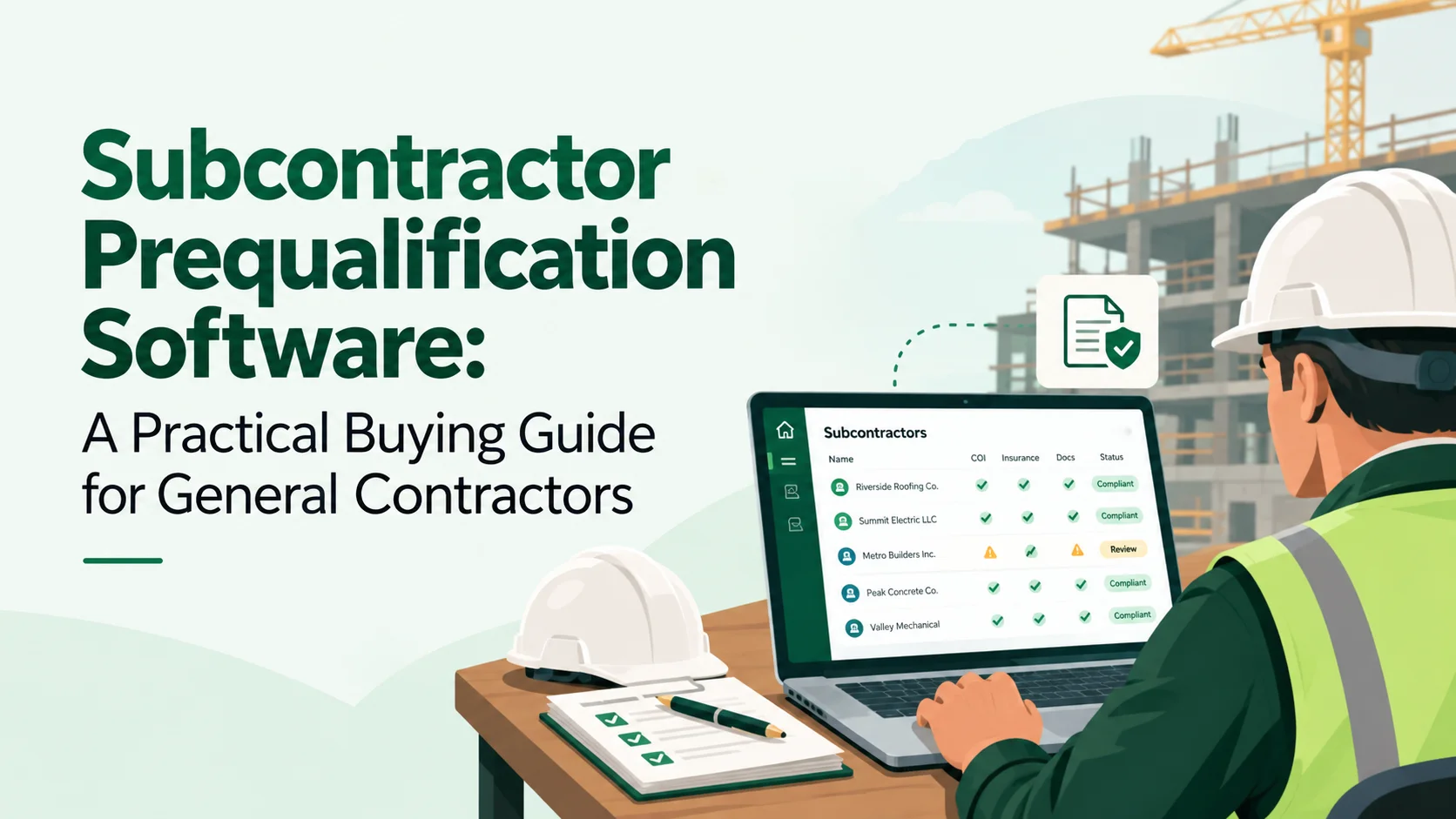
A stronger workflow keeps the W-9 attached to a single subcontractor record and connects that record to projects, contracts, insurance documents, and review status.
The workflow can be as simple as:
Subcontractor added → W-9 requested → W-9 uploaded → review → accepted/exception → stored with vendor record
The important part is that the document has a clear owner, status, and location rather than being buried in an email attachment.
SubCada can help contractors centralize subcontractor compliance documents and track the status of records alongside insurance and other project requirements.
Frequently asked questions
Does every subcontractor need to fill out a W-9?
Not every payment relationship is identical. The W-9 is generally used when a business determines it is paying a U.S. person as an independent contractor and needs the payee's TIN and certifications. Confirm exceptions with your tax professional.
Does a W-9 prove that someone is an independent contractor?
No. The IRS says worker classification depends on the facts and circumstances of the relationship. A W-9 is a tax information form, not a substitute for a classification analysis. citehttps://www.irs.gov/businesses/small-businesses-self-employed/independent-contractor-defined
Do I send a W-9 to the IRS?
Generally, the completed W-9 is provided to the payer, who keeps it in its records. The IRS says to keep it in the payer's files for four years. citehttps://www.irs.gov/businesses/small-businesses-self-employed/forms-and-associated-taxes-for-independent-contractors
Is a W-9 the same as a 1099?
No. The W-9 supplies payee information to the payer. The 1099-NEC is used by the payer to report qualifying nonemployee compensation.
Should a GC keep W-9s with COIs?
They can be kept in the same subcontractor record for operational convenience, but they are different document types with different purposes and retention considerations.
Final takeaway
For a general contractor, the W-9 is a small document with an important administrative role. Collect it as part of a structured subcontractor onboarding process, review it for completeness and consistency, protect the taxpayer information it contains, and keep it accessible to the people responsible for vendor and tax reporting.
The biggest operational mistake is not failing to understand every tax rule. It is allowing required vendor documents to become scattered across email, spreadsheets, accounting folders, and project files.
A centralized subcontractor record makes it easier to see what has been received, what still needs attention, and where the latest document is stored.
This article is for general informational purposes and is not tax, legal, or accounting advice. Consult your tax professional or legal counsel for questions about worker classification, reporting, withholding, or your specific vendor relationships.