

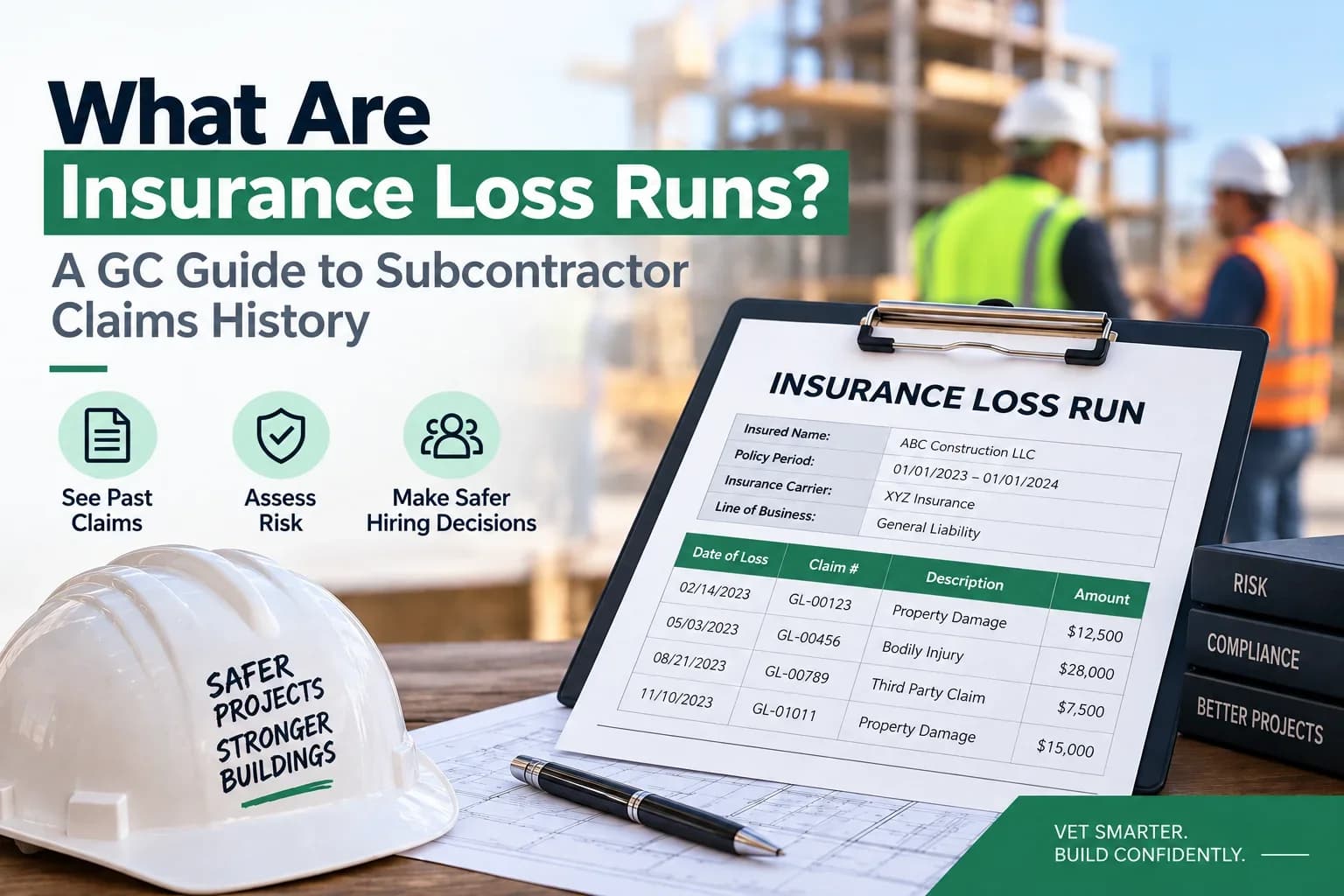
When a general contractor prequalifies a subcontractor, a certificate of insurance answers one question: what insurance does the subcontractor report having? A loss run answers a different question: what claims have actually been reported under that insurance?
That distinction matters when a GC is evaluating a subcontractor for a higher-risk project, reviewing an unusual claims history, or deciding what additional documentation belongs in the qualification file.
This guide explains what loss runs are, what information they contain, how they differ from a COI, what GCs should request, and how to organize them as part of a repeatable subcontractor compliance process.
What is an insurance loss run?
An insurance loss run is a claims-history report produced from an insurer's records. It generally lists claims associated with a policy or insured for a specified period, along with information such as dates of loss, claim status, amounts paid, reserves, and descriptions of the loss.
The exact format varies by insurer and line of coverage. Unlike an ACORD 25 certificate, there is no single universal loss-run layout that every carrier must use.
For a GC, the important point is that a loss run provides historical claims information that a certificate of insurance does not.
Why would a general contractor request loss runs from a subcontractor?
A GC may request loss runs as part of prequalification or risk review when the project, owner, insurer, contract, or internal policy calls for more information than a COI provides.
Loss history can help a GC understand questions such as:
- Has the subcontractor reported repeated claims?
- What types of losses has the company experienced?
- Are claims still open?
- Are there significant recent losses that deserve additional review?
- Does the subcontractor's stated safety or risk-management story align with its claim history?
- Does the company have enough operating history to evaluate?
Loss runs should be treated as one input into a broader qualification process, not as an automatic pass/fail document.
Loss run vs. certificate of insurance
A COI and a loss run serve different purposes. For a deeper explanation of COIs, see What Is a Certificate of Insurance (COI)? Complete Contractor Guide.
| Document | Main purpose | What it can tell a GC |
|---|---|---|
| Certificate of Insurance | Summarizes current reported insurance information | Carrier, policy dates, limits, coverage lines and certificate details |
| Loss run | Shows historical reported claims | Claim dates, status, paid amounts, reserves and loss descriptions |
| Policy/endorsement | Shows contractual insurance terms | Actual coverage language, exclusions and endorsements |
| EMR worksheet/letter | Shows workers' compensation experience rating information | Experience modification information and applicable period |
A current COI does not replace a loss run when a project or qualification process specifically requires claims history.
What should a GC look for on a loss run?
The first step is to understand what the report actually covers. Check the insured name, policy period, line of coverage, and valuation date before interpreting individual claims.
1. Named insured
Confirm that the loss run belongs to the same legal entity being evaluated. A DBA, parent company, affiliate, or similarly named company can create confusion.
2. Policy period
Check the dates covered by the report. A request for several years of history should clearly identify which policy years are included.
3. Valuation date
Claims can change as they are investigated and resolved. Look for an as-of or valuation date so the GC knows when the information was current.
4. Open and closed claims
Open claims deserve attention because the eventual cost and outcome may not yet be final. A closed claim is not automatically harmless either; the type and severity of the loss can still provide useful context.
5. Paid and reserved amounts
Many loss runs distinguish amounts already paid from amounts reserved for future payments. Do not treat a reserve as the same thing as a final claim cost.
6. Type and frequency of claims
Look for patterns rather than focusing on a single number. Multiple similar losses may raise a different question than one isolated event.
How many years of loss runs should a GC request?
There is no universal number that applies to every construction project. The appropriate period can depend on the GC's qualification policy, owner requirements, insurance program, project risk, subcontractor history, and the instructions from the GC's insurance or risk professionals.
Some construction qualification processes request several years of history. For example, current GC prequalification materials can request three years of OSHA records and EMR information, while insurance applications and programs may request longer loss histories. urlDPR subcontractor prequalification requirementshttps://cmicr12web.dpr.com/cmicprod/PmSsPrequal/SaveSSPrequalP6.do?navPage=6&saveDraft=Y
The practical rule is simple: define the required period in the qualification checklist instead of asking every subcontractor for an inconsistent amount of information.
Should loss runs be requested for every insurance policy?
Not necessarily. The requirement should match the risk review being performed.
A GC may distinguish between general liability, workers' compensation, automobile liability, or other relevant lines. If claims history is required for multiple coverage lines, the request should identify each one clearly.
For example:
General liability: three most recent policy years, currently valued.
Workers' compensation: three most recent policy years, currently valued.
The exact requirements should come from the GC's qualification policy, contract, insurance advisor, or project requirements.
How should a GC request loss runs?
A written request can make the process easier for both the subcontractor and its insurance agent.
A practical request might say:
Please provide currently valued loss runs for the requested policy years for the applicable coverage lines. Please include the insured legal name, policy periods, and valuation date.
If the subcontractor's insurance agent normally provides the report, the GC can direct the request to the appropriate insurance contact.
What if the subcontractor has no loss history?
A newer subcontractor may have limited operating history, while a small company may have different reporting circumstances than a large established contractor.
Do not automatically interpret missing history as a negative claim record. Record what was actually provided and follow the GC's qualification procedure for companies with limited history.
For example:
Status: Conditional review — subcontractor has two years of available loss history; third requested year unavailable because the entity did not maintain that coverage during the period.
That is more useful than simply marking the subcontractor as “approved” or “rejected” without an explanation.
How loss runs fit into subcontractor compliance
Loss runs are usually more closely associated with qualification and risk review than routine expiration tracking. That makes them different from documents such as COIs and licenses, which often require recurring renewal monitoring.
A useful compliance workflow can separate documents into three groups. For the broader qualification process, see Subcontractor Prequalification: What to Check Before You Hire a Subcontractor.
Recurring documents
- Certificates of insurance
- Licenses
- Required endorsements
- Other documents with expiration dates
Qualification documents
- Loss runs
- EMR documentation
- Financial information
- References
- Project history
Project-specific documents
- Site-specific safety plans
- Project-required certifications
- Special insurance endorsements
- Owner-required forms
This structure prevents a GC from treating every document as if it has the same review cycle.
Common mistakes when managing subcontractor loss runs
Mistake 1: Treating a COI as a substitute
A COI summarizes insurance information. It does not provide the detailed historical claims information contained in a loss run.
Mistake 2: Ignoring the valuation date
Claims can develop over time. A report should be evaluated with its reporting date in mind.
Mistake 3: Comparing claim totals without context
Claim severity, coverage line, claim status, subcontractor size, operations, and other factors matter. A raw total should not be treated as a complete risk assessment.
Mistake 4: Saving the report without the review record
If a GC collects a loss run but never records whether it was reviewed, the file may still be difficult to audit later.
Mistake 5: Re-requesting everything from scratch
If company-level qualification information is still valid, a centralized record can reduce unnecessary duplicate requests while allowing project-specific requirements to be added when needed.
A simple loss-run review checklist
- [ ] Legal entity name matches the subcontractor record
- [ ] Requested policy years are included
- [ ] Applicable coverage lines are identified
- [ ] Valuation date is recorded
- [ ] Open claims are identified
- [ ] Significant losses are flagged for appropriate review
- [ ] Missing history is documented
- [ ] Reviewer and review date are recorded
- [ ] Any qualification exception is documented
- [ ] Supporting documents are stored with the subcontractor record
How to organize loss runs across many subcontractors
The administrative challenge grows quickly when a GC manages dozens or hundreds of trade partners. For a broader approach to managing compliance across projects, see How to Track Subcontractor Compliance Across Multiple Projects. A loss run can end up in an email attachment, a prequalification portal, a shared drive, or a project folder with no obvious connection to the subcontractor's current compliance record.
A better workflow is to maintain one master subcontractor record and associate qualification documents with it. Then project-specific requirements can be added without losing the company's historical record.
SubCada can help GCs organize subcontractor compliance documents and status information in one place, reducing the need to search through email threads and disconnected folders when a qualification or audit question comes up.
Frequently asked questions
Is a loss run the same as a COI?
No. A COI summarizes insurance information, while a loss run reports historical claims information.
Are loss runs required for every subcontractor?
Not universally. The requirement depends on the GC's process, project, contract, insurer, owner, and risk profile.
How far back should loss runs go?
There is no single universal period. The GC should define the required history based on its qualification and risk-management requirements.
Does a loss run show the subcontractor's current insurance coverage?
Not in the same way a current COI does. A loss run is primarily historical claims information and should not replace current insurance verification.
Should open claims automatically disqualify a subcontractor?
Not necessarily. An open claim should trigger appropriate review, but the decision should consider the nature of the claim, circumstances, current controls, contract requirements, and the GC's qualification policy.
Who normally provides a loss run?
The subcontractor's insurance carrier or insurance agent can typically provide the report. The exact process varies by carrier and broker.
Final takeaway
Loss runs give general contractors a view of a subcontractor's historical claims experience that a certificate of insurance cannot provide. The most useful approach is to define when loss runs are required, specify the requested policy years and coverage lines, verify the report's identity and valuation date, document the review, and keep the result connected to the subcontractor's qualification record.
For GCs managing a growing subcontractor network, the goal is not simply collecting more documents. It is maintaining a clear, current record of what was requested, what was received, what was reviewed, and what still needs attention.
This article is general informational content and is not legal, insurance, or risk-management advice. Project-specific requirements should be reviewed with qualified professionals.